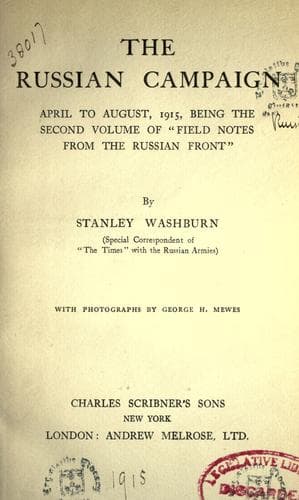
The Russian Campaign, April to August, 1915: Being the Second Volume of "Field Notes from the Russian Front"Washburn, Stanley
History
The Russian Campaign, April to August, 1915: Being the Second Volume of "Field Notes from the Russian Front"
Washburn, Stanley
World War, 1914-1918 -- Campaigns -- Eastern Front; World War, 1914-1918 -- Personal narratives
There is a tendency to welcome the German impetuosity of attack, for
each fresh irruption means a weakening of the enemy. The Russian
theory is that Russia can stand the losses, large as they are, almost
indefinitely, and that she is willing to take the burden of breaking
the German wave again and again if need be, knowing that each assault
of the enemy is bringing them nearer and nearer to the end of their
tether. Since the latest irruption into Galicia we hear less talk of
a Russian advance in the near future, but certainly not a sign of
discouragement in any of the high quarters. One may well believe that
this last outburst was not anticipated, but the Russians over on this
side are as ready to “play” the fish now as they were when the war
first started. It was hoped after the January-February attacks, that
the enemy was exhausted and the time was in sight when the gaff might
be of use. Now the fish has taken another spurt, and the Russians are
letting out the line again and are prepared to let it have another
fling in their waters. But they believe none the less that the enemy is
firmly hooked, and that it is merely a question of time when from sheer
exhaustion he will tire and they may begin to drive home their own
attacks.
The Russian attitude is very philosophical, and though a people who
are temperamentally not without a vein of melancholy, they take this
war with much more equanimity than one could have imagined possible.
Retreats and shifting of lines no longer create panics over here.
People are sorry. They had hoped that the Germans were nearer the
point of exhaustion, but there is not the slightest indication of
discouragement. Probably their attitude is due primarily to the fact
that they had never anticipated an easy victory nor a short war. They
knew from the start that they were in for a terrific ordeal, and what
goes on day after day, with its ebbs and its floods, is merely a
matter of the day’s work with them. They have seen again and again the
irruptions of the Germans gradually absorbed by their troops, and each
set back now is accepted as only temporary. The movement of the Germans
in Courland has hardly made any impression at all in Russia generally,
if the reports one hears are true.
[Illustration: Russian soldiers performing their native dance.]
The Russians had practically no troops in that province, which itself
offered no great strategic advantage to the Germans. Taking advantage
of this weak spot, the Germans with a number of corps--it is placed as
high as three--poured into the almost unprotected country.
Public-domain text, read in full here on John Shaqi.
Reviews
Reviews
No reviews yet
Be the first to share your thoughts on this work.
Join the Discussion
Join the discussion
Sign in to leave a comment or review.
Sign InorCreate an account