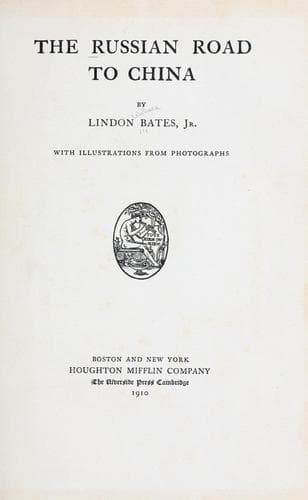
China -- Description and travel; Siberia (Russia) -- Description and travel; Velikaia Siberskaia magistral
The train leaves the station, which is at a distance from the town, and
once more we are en route. The eye rests gratefully upon the ribbon
of cultivated fields which follow the Irtish down. But we reënter the
steppe, and again the desolation settles over all. In hours of
looking, not a habitation is seen, not an animal, not a tree,--only
the same white billows. This Barbara district in the Tomsk Government
has an area of fifty thousand square miles. Kainsk, some seven hundred
versts from Chelliabinsk, is the centre. The section, though covered
with the fertile black earth of the adjoining regions, is, owing to
lack of drainage and adequate rainfall, arid and almost untilled.
The round-faced civilian from the compartment further up, whose
familiarity with the country has made him a welcome accession, joins us
at the window. He looks out over the level plain of the Barbara Steppe
with manifest satisfaction.
“You admire the landscape?” we ask satirically.
He smiles. “We got big money when the line went through here. I made my
first fortune then.”
He sighs at the memory of old times, and tells of the railway-building
days when the Czar had given the order for a road across the continent,
and the soldiers of fortune, of whom he was one, had gathered to the
task.
“Not a kopeck had I when the Dreyfus brothers made their big
speculation in Argentine wheat and went down, leaving us young clerks
stranded in Kiev. You know Kiev? Great pilgrimages come there to see
the bodies of Joseph and his brethren, all preserved just as when they
died. We heard by accident of a grading job under a big contractor out
here. None of us knew anything about construction, but three of us
grain-clerks wrote a letter saying we would put the work through, and
started. We had just enough money to get to Samara. In Samara was a
merchant much esteemed, whom I went to see. He went on our bond, never
having seen us before, and gave us enough money to come. So it was in
the old days. The country was flat as a board. We had but to lay down
the ties and spike the rails. Thirty versts we made of this line. It
cost us thirty thousand roubles a verst, but we got fifty thousand.
Would that we might do that now again.”
The contractor, his round jolly face glowing with the recital and his
eyes shining through gold-rimmed glasses, is entertaining a growing
company, for the judge has stopped to gossip, and the railroad official.
“I took my money and bought an estate in the country of the Don
Cossacks,” the contractor is saying. “I paid ten per cent to the
Government for taxes when I bought the land. I had to pay no more taxes
then all my life, but my heir would pay taxes, or, if I sold, he who
bought would pay. So it was done in the Hataman Government.”
“It is just,” says the judge. “Why should they, who get the property,
not pay taxes?”
Public-domain text, read in full here on John Shaqi.
Reviews
Reviews
No reviews yet
Be the first to share your thoughts on this work.
Join the Discussion
Join the discussion
Sign in to leave a comment or review.
Sign InorCreate an account