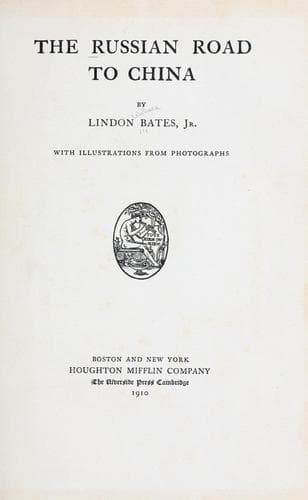
China -- Description and travel; Siberia (Russia) -- Description and travel; Velikaia Siberskaia magistral
In 1637 the Cossacks reached and established themselves in Yakutsk. In
1639 by the far northern route they pierced to the Sea of Okhotsk. In
1644 a party reached the delta of the Kalyma, and curiously speculated
upon the mammoth tusks which they found. In 1648, on the Cellinga
River beyond Lake Baikal they built Fort Verhneudinsk. Had their tide
of conquest now rolled southward, up the Cellinga Valley, the Russian
Eagles might to-day be flying over Peking. Only the Kentai Mountains
were between them and prostrate Mongolia, enfeebled by the internecine
warfare of her rival khans. From Mongolia, the road, worn by so many
conquerors of old, leads fair and clear to the Chi-li Province and the
heart of China.
But they passed this gateway by, those old Cossack heroes, as the
railway builders have passed it by, to press with Poyarkov to the
Pacific; to conquer, with Khabarov, the Amur; to meet in desperate
conflict the whale-skin cuirassed Koriats of the coast; to battle with
the Manchu in conflicts where “by the Grace of God and the Imperial
good fortune, and our efforts, many of those dogs were slain”; to fight
until but an unvanquished sixty-eight were left of the garrison of
eight hundred in beleaguered Albazin.
The current of conquest passed by this door to China, but the swelling
stream of commerce searched it out. In 1638, the Boyar Pochabov,
crossing Baikal on the ice, broke the first way to Urga, the capital of
the Mongolian Great Khan, and gained the friendship of the monarch. In
the interests of trade, the deputies of the Czar Alexei Michailovitch
followed up the opening with an embassy in 1654 to the Chinese Emperor
himself. Over steppe and mountain and desert the mission wound its
weary way to Kalgan, the outpost city beside the Chinese Wall, and then
on to Peking, bearing to the Bogdo Khan, the Yellow Czar, the presents
of Chagan Khan, the White Czar.
From the Forbidden Palace at Peking were started back, four years
later, return presents, including ten _puds_ of the first tea that
reached Russia. With the presents came a message that drove flame into
the bearded cheeks of the Czar and set his Muscovite boyars to grasping
their sword-hilts. “In token of our especial good-will we send gifts in
return for your tribute.” Thus, the Chinese Emperor.
The answer of the Czar started another legation plodding across a
continent, and the retort was thrown at the feet of his Yellow Majesty.
It was a summons forthwith to tender his vassalage to Russia. The
Czar’s gauntlet had been hurled across Asia. But all it brought was
beggary to the traders who had begun to press along the newly-opened
route to a commercial conquest of the East.
Public-domain text, read in full here on John Shaqi.
Reviews
Reviews
No reviews yet
Be the first to share your thoughts on this work.
Join the Discussion
Join the discussion
Sign in to leave a comment or review.
Sign InorCreate an account