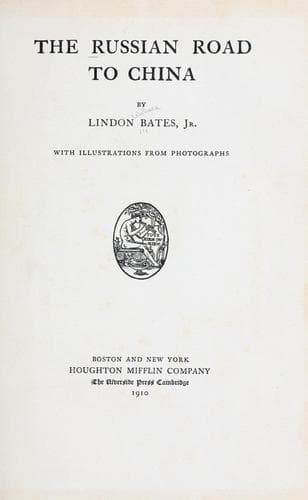
China -- Description and travel; Siberia (Russia) -- Description and travel; Velikaia Siberskaia magistral
Soon Russia regretted the fruitage of her challenge. In 1685 Golovin’s
embassy left Moscow, and, arriving two years later at Verhneudinsk,
opened negotiations with Peking. A Chinese commission then made its way
north, and at Nerchinsk, August 27, 1689, was signed the famous treaty
closing to Russia her Amur outlet to the Pacific, purchased with such
desperate valor at Albazin, but granting to a limited number of Russian
merchants trading privileges into China.
A lively traffic at once sprang up. Long caravans, silk- and tea-laden,
crossed the Mongolian deserts, the Siberian steppes and hills, and the
forested Urals, taking the road to Europe. A little Russian settlement
was founded at Peking, and a traders’ caravansary was built. The church
constructed by the prisoners of Albazin, who had been so kindly treated
by the Manchus that they at first refused the release which the treaty
brought, gave place to a larger edifice erected by popes from Russia.
Soon, however, the Russians again offended the Celestial Emperor. In
their riotous living, the quickly enriched merchants disquieted the
sober Chinese. The Siberians over the frontier gave asylum to a band
of seven hundred Mongol free-booters, whom it was urgently desired to
present to a Chinese headsman. So commerce was forbidden anew, and
most of the reluctant merchants left their compound. Some stayed and
assimilated with the Chinese, retaining, however, their religion; and
for years a mixed race observed in Peking the rites of Greek Orthodox
Christianity.
It may seem strange that rulers so energetic as Peter the Great and
some of his successors took no steps to resent by force of arms the
arbitrary acts of the Chinese Emperor. But much was going on in
Russia; Peter was occupied with his invasion of Persia, and Catherine
was without taste for a distant and doubtful campaign. The garrisons
scattered over the enormous area of Siberia were numerically too weak
and too poorly equipped to do more than hold their own. So, when
commerce was once more interdicted and the merchants banished, recourse
was had to diplomacy. In 1725 the Bogdo Khan relented enough to receive
Count Ragusinsky with a special embassy from Catherine the First, which
arranged the second great agreement with China, called the Treaty of
Kiahta.
Public-domain text, read in full here on John Shaqi.
Reviews
Reviews
No reviews yet
Be the first to share your thoughts on this work.
Join the Discussion
Join the discussion
Sign in to leave a comment or review.
Sign InorCreate an account