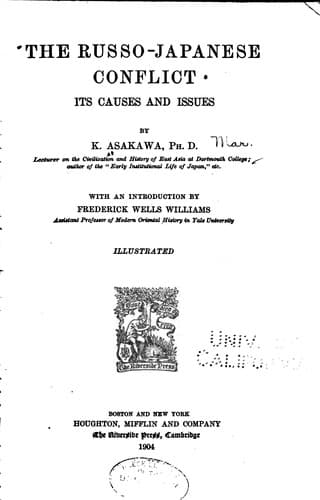
The Russo-Japanese Conflict: Its Causes and IssuesAsakawa, Kan'ichi
History
The Russo-Japanese Conflict: Its Causes and Issues
Asakawa, Kan'ichi
Russo-Japanese War, 1904-1905; Russo-Japanese War, 1904-1905 -- Causes
strange that, in the opinion of Lord Lansdowne, the “Agreement most
unquestionably extended to Manchuria, which is part of the Chinese
Empire,”[316] while, from Count von Bülow’s point of view, “The
Anglo-German Agreement had no reference to Manchuria.” “I can imagine
nothing,” he added, “which we can regard with more indifference” than
Manchuria.[317] Evidently Germany had entered into the Agreement with
different motives from those of Great Britain, and perhaps also with
less zeal, if zeal there was.
-----
Footnote 300:
_China, No. 7 (1901)_, Nos. 21, 76, 81, 84, 86, 95, 103, 149, 153,
154, 174, 187, 189.
Footnote 301:
_Ibid._, Nos. 1 and 7.
Footnote 302:
_Ibid._, Nos. 2, 7, 9.
Footnote 303:
_China, No. 7 (1901)_, Nos. 11, 14, 19, 20, 22, 23, 25, 30, 35, 36,
57, 60, 103.
Footnote 304:
_Ibid._, Nos. 24, 27, 37, 38, 43, 50, 54, 55, 66, 68.
Footnote 305:
_Ibid._, Nos. 39, 77.
Footnote 306:
_Ibid._, 40, 78.
Footnote 307:
The _British Parliamentary Papers_, _Treaty Series_, No. 1, 1900.
Footnote 308:
On November 1, Lord Salisbury wrote to the British _Chargé_ at St.
Petersburg in unusually outspoken language, as follows: “In the event
of the Russians making any complaint of our having concluded the
Anglo-German Agreement without previously consulting them, you should
dwell on the fact that the conduct and language of Russian officers in
the Far East, in respect to the Chinese railway from Niu-chwang to
Peking, and the way in which the property of British subjects on that
railway has been dealt with by the Russian military authorities, has
caused much perplexity to Her Majesty’s Government. The Russian
Government have given us many satisfactory assurances with respect to
their intentions in these matters, but the little attention paid to
the avowed policy of the Russian Government by officers on the spot
has deterred us from fuller communication.”—_China, No. 7 (1901)_, No.
45.
Footnote 309:
See, for instance, the explanation offered in _Tokushu Jōyaku_, pp.
384–386.
Footnote 310:
_China, No. 5 (1901)_, Nos. 4 and 7, inclosure 2.
Footnote 311:
_Ibid._, Nos. 6, 8, and 9.
Footnote 312:
The 56th Congress, 2d Session, _Home Documents_, vol. i. p. 355.
Footnote 313:
The italics are the author’s.
Footnote 314:
_China, No. 5 (1900)_, No. 5.
Footnote 315:
Also see the debate in the House of Lords, on August 6, 1901, between
Earl Spencer and the Marquess of Lansdowne. The _Parliamentary
Debates_, Fourth Series, vol. 98, pp. 1351–1365.
Footnote 316:
At the House of Lords, on August 6, 1901. The Japanese Government,
also, in its reply to a question of a member of the National Diet,
interpreted the Agreement to apply to the whole of the Chinese
Empire.—_Tokushu Jōyaku_, p. 389.
Footnote 317:
Public-domain text, read in full here on John Shaqi.
Reviews
Reviews
No reviews yet
Be the first to share your thoughts on this work.
Elsewhere in the archive
Join the Discussion
Join the discussion
Sign in to leave a comment or review.
Sign InorCreate an account