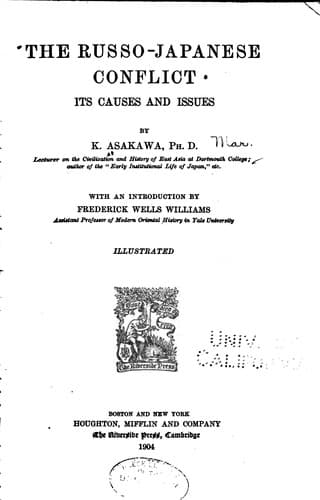
The Russo-Japanese Conflict: Its Causes and IssuesAsakawa, Kan'ichi
History
The Russo-Japanese Conflict: Its Causes and Issues
Asakawa, Kan'ichi
Russo-Japanese War, 1904-1905; Russo-Japanese War, 1904-1905 -- Causes
At the Reichstag on March 15, 1901.—The London _Times_, August 6,
1901, p. 7. He is also said to have declared to the Russian
Representative at Berlin that Manchuria was outside of the sphere of
German commercial rights, and consequently had no relation with the
Anglo-German Agreement. It was reported even that Manchuria was
originally mentioned specifically in the British draft of the
Agreement, but the word was struck out at the request of Germany, and
the more abstract phrase, “spheres of influence,” was used
therefor.—_Tokushu Jōyaku_, pp. 388–389.
CHAPTER IX
A _MODUS VIVENDI_: THE ALEXIEFF-TSÊNG AGREEMENT
In the mean time, the Chinese Court[318] having largely emancipated
itself from the sway of the reactionary Prince Tuan and his associates,
the Representatives at Peking of the eleven interested Powers had agreed
in September to open discussions among themselves of the terms of peace
to be presented to the Chinese plenipotentiaries, Prince Ching and Li
Hung-chang.[319] The German Government, however, proposed, as a
prerequisite of peace negotiations with China, a drastic measure
demanding the surrender to the Powers of the chief culprits of the
recent trouble. The proposition meeting little encouragement from other
Ministers, Germany presented a new condition on October 3. The latter
was, however, supplanted by the basis for negotiations formulated on
September 30 and presented five days later to the Powers by the French
Minister.[320] His proposals, to which Russia immediately assented,[321]
and which with important amendments[322] and additions became the basis
of the Protocol signed on September 7, 1901, comprised the following six
points: (1) the punishment of the chief offenders designated by the
Representatives of the Powers at Peking; (2) maintenance of the
prohibition of the importation of arms into China; (3) indemnities for
the foreign governments, societies, and individuals; (4) establishment
of a permanent legation guard at Peking; (5) dismantlement of the Taku
forts; and (6) military occupation of two or three points on the road
from Tientsin to Taku, so as to keep open the passage between Peking and
the sea. It is needless for us to follow the negotiations which
proceeded at Peking after these proposals were made by France, but it is
important to observe that the French propositions were limited, in the
first place, to North China, and, in the second place, to those
questions in North China which concerned all the Powers alike. The
significance of all this, or at least of the prompt assent of
Russia,[323] may well be inferred from the opposition as readily offered
by the latter when Germany[324] and Japan,[325] respectively, urged that
a proper mention should be made in the peace protocol of China’s consent
to repair the murder of Baron von Ketteler and the Chancellor Sugiyama.
Russia maintained that “proposals of this nature, serving principally as
Public-domain text, read in full here on John Shaqi.
Reviews
Reviews
No reviews yet
Be the first to share your thoughts on this work.
Elsewhere in the archive
Join the Discussion
Join the discussion
Sign in to leave a comment or review.
Sign InorCreate an account