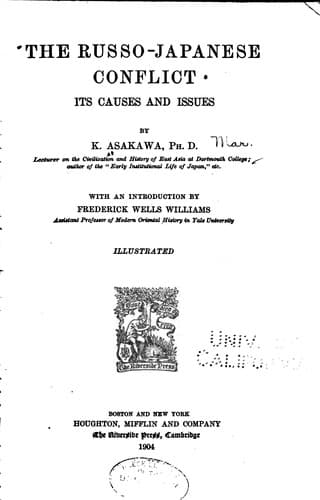
The Russo-Japanese Conflict: Its Causes and IssuesAsakawa, Kan'ichi
History
The Russo-Japanese Conflict: Its Causes and Issues
Asakawa, Kan'ichi
Russo-Japanese War, 1904-1905; Russo-Japanese War, 1904-1905 -- Causes
a satisfaction to be given to private views of one State, ought not to
enter into the common programme of the collective demands, which had as
their object the interests of all the Powers collectively and the
reëstablishment of a normal state of affairs in the Celestial
Empire.”[326] “In the Chinese question it is advisable,” said the
_Official Messenger_ of St. Petersburg, “not to lose sight of the
necessity of distinguishing clearly the questions which interest each of
the Powers in particular and those which affect the interests of all the
Powers in general.”[327] This distinction had been fundamental in the
Russian diplomacy in China since 1900, for, if one question of the
former class was allowed to be dealt with in the common deliberation of
the Representatives of all the Powers, why should not another question
of the same class be similarly treated? Or, in other words, if the
Sugiyama affair was referred to the collective council, the argument
that the Manchurian problem should be solved solely by Russia, without
intervention of the other Powers, would lose much of its force.[328] The
ultimate failure of Russian diplomacy—for diplomacy has failed when it
ends in a war, and, if Russia does succeed, her success will be that of
force, not of diplomacy—may be said to be largely due to the evident
contradiction of this fundamental distinction between North China and
Manchuria, upon which she sought to build her entire diplomatic
structure in this crisis. As a matter of fact, it was as impossible to
deny the profound interest felt by Great Britain and the United States,
and, above all, by Japan, in the economic development of Manchuria, as
it would have been to exclude Russia from the community of the Powers in
North China. It should be remembered that Russia herself persistently
maintained that the principle of the integrity of China applied also to
Manchuria, and she would have hardly antagonized other Powers had she
expressed an equally clear adhesion to the principle of the open door,
and made efforts to carry out pledges regarding both principles.
Public-domain text, read in full here on John Shaqi.
Reviews
Reviews
No reviews yet
Be the first to share your thoughts on this work.
Elsewhere in the archive
Join the Discussion
Join the discussion
Sign in to leave a comment or review.
Sign InorCreate an account