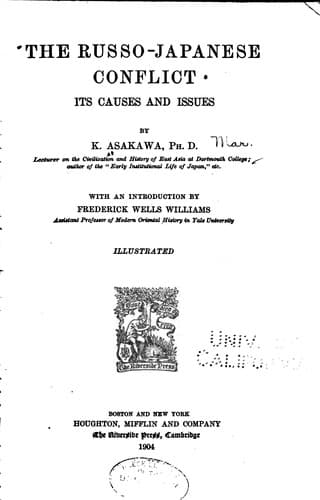
The Russo-Japanese Conflict: Its Causes and IssuesAsakawa, Kan'ichi
History
The Russo-Japanese Conflict: Its Causes and Issues
Asakawa, Kan'ichi
Russo-Japanese War, 1904-1905; Russo-Japanese War, 1904-1905 -- Causes
Events soon took place, however, which made other Powers skeptical of
Russia’s sincerity in her profession of even the principle of the
integrity of the Chinese Empire. The new question thus thrust upon the
attention of the Powers was of an extremely grave nature, for if the
sovereignty of Manchuria should eventually pass into the hands of
Russia, the treaty rights that other nations had acquired therein from
China might rightfully be terminated by Russia. Whatever her ultimate
objects, it was hardly politic for her to approach the difficult
Manchurian question at the time and in the manner selected by her. Dr.
George Morrison reported to the _Times_ on December 31, 1900, and Sir
Ernest Satow, the British Minister at Peking, confirmed it as
authentic,[329] that the delegates of Admiral Alexieff and the Tartar
General Tsêng-chi, of Mukden, had signed, in November last, an agreement
whereby Russia consented to return to the Chinese the civil government
of the Southern Province of Fêng-tien (Sheng-king) in Manchuria, on the
following conditions:—
1. “The Tartar General Tsêng undertakes to protect the province and
pacify it, and to assist in the construction of the railroad.
2. “He must treat kindly the Russians in military occupation,
protecting the railway and pacifying the province, and provide them
with lodging and provisions.
3. “He must disarm and disband the Chinese soldiery, delivering in
their entirety to the Russian military officials all munitions of
war in the arsenals not already occupied by the Russians.
4. “All forts and defenses in Fêng-tien not occupied by the
Russians, and all powder magazines not required by the Russians,
must be dismantled in the presence of Russian officials.
5. “Niu-chwang and other places now occupied by the Russians shall
be restored to the Chinese civil administration when the Russian
Government is satisfied that the pacification of the provinces is
complete.
6. “The Chinese shall maintain law and order by local police under
the Tartar General.
7. “A Russian Political Resident, with general powers of control,
shall be stationed at Mukden, to whom the Tartar General must give
all information respecting any important measure.
8. “Should the local police be insufficient in any emergency, the
Tartar General will communicate with the Russian Resident at Mukden,
and invite Russia to dispatch reinforcements.
9. “The Russian text shall be the standard.”[330]
Public-domain text, read in full here on John Shaqi.
Reviews
Reviews
No reviews yet
Be the first to share your thoughts on this work.
Elsewhere in the archive
Join the Discussion
Join the discussion
Sign in to leave a comment or review.
Sign InorCreate an account