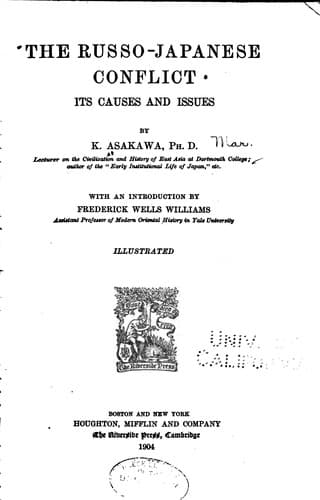
The Russo-Japanese Conflict: Its Causes and IssuesAsakawa, Kan'ichi
History
The Russo-Japanese Conflict: Its Causes and Issues
Asakawa, Kan'ichi
Russo-Japanese War, 1904-1905; Russo-Japanese War, 1904-1905 -- Causes
In brief, the province was to be disarmed, its military government to be
in the Russian hands, its civil government to be placed under the
supervision of a Russian Resident, with additional duties on the part of
the Chinese to provide for the Russian military and to protect Russian
properties. The last provisions were coupled with the right of the
Russians to supply reinforcements, if the Chinese local police should
prove insufficient. The probable significance of this measure will be
fully discussed in connection with the Russo-Chinese Convention of April
8, 1902. As regards the Agreement now under discussion, Dr. Morrison
opined that it would necessarily be followed by similar agreements with
reference to the other two of the three Eastern Provinces,[331] and then
all Manchuria would be “a _de facto_ Russian protectorate, Russia by a
preëxisting agreement having already the right to maintain all necessary
troops for the protection of the railway.” It is needless to say that
the report of this Agreement caused universal amazement in the
diplomatic world. It soon became known[332] that the Chinese delegate
who signed it at Port Arthur had received no authorization to do so from
the Peking Government.[333] But the Japanese Government, hearing from a
reliable source that so late as the beginning of February, Russia was
pressing China to ratify the Agreement, undertook to express its opinion
to the Chinese Minister at Tokio, that the conclusion of any such
agreement would be a “source of danger” to the Chinese Government, and
that no arrangement affecting territorial rights of the Empire ought to
be concluded between the Chinese Government and any one of the
Powers.[334] At the instance of Japan, Great Britain also made precisely
the same representation to China,[335] Germany following the example in
slightly different language,[336] and the United States also reminding
China of “the impropriety, inexpediency, and even extreme danger to the
interests of China, of considering any private territorial and financial
engagements, at least without the full knowledge and approval of all the
Powers now engaged in negotiation.”[337]
Public-domain text, read in full here on John Shaqi.
Reviews
Reviews
No reviews yet
Be the first to share your thoughts on this work.
Elsewhere in the archive
Join the Discussion
Join the discussion
Sign in to leave a comment or review.
Sign InorCreate an account