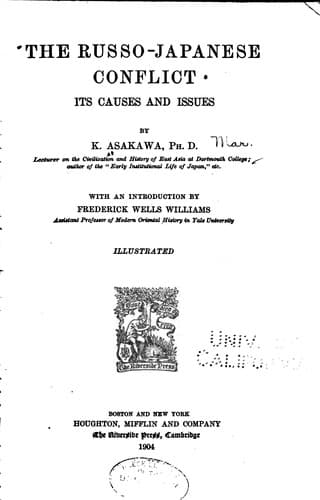
The Russo-Japanese Conflict: Its Causes and IssuesAsakawa, Kan'ichi
History
The Russo-Japanese Conflict: Its Causes and Issues
Asakawa, Kan'ichi
Russo-Japanese War, 1904-1905; Russo-Japanese War, 1904-1905 -- Causes
It has often been reported in the press that the Agreement was never
ratified by either China or Russia. Before, however, any of the protests
of the Powers reached the Peking Government, Count Lamsdorff had, on
February 6, “very readily” explained the situation to the British
Ambassador at St. Petersburg. He said it was quite untrue that any
agreement which would give Russia new rights and a virtual protectorate
in Southern Manchuria had been concluded or was under discussion with
China, but “the Russian military authorities who had been engaged in the
temporary occupation and pacification of that province had been
directed, when reinstating the Chinese authorities in their former
posts, to arrange with the local civil authorities a _modus vivendi_ for
the duration of the simultaneous presence of Russian and Chinese
authorities in Southern Manchuria, the object being to prevent the
recurrence of disturbances in the vicinity of the Russian frontier, and
to protect the railway from the Russian frontier to Port Arthur.” “Some
of the details of the proposed _modus vivendi_ had been sent for
consideration to St. Petersburg, but no convention or arrangement with
the central Government of China or of a permanent character had been
concluded with regard to Manchuria, nor had the Emperor any intention of
departing in any way from the assurances which he had publicly given
that Manchuria would be entirely restored to its former condition in the
Chinese Empire as soon as circumstances admitted of it.”[338] A careful
reading of this statement, as typical of the many declarations made by
Russia in regard to Manchuria, will show how untenable is the popular
view that she persistently falsifies. There is here a fair admission
that a _modus vivendi_ was under way between the Russian military
officers in Southern Manchuria and the local Chinese authorities, and
that it was not of a permanent nature, nor was it concluded with the
central Government at Peking, and both of these points accord with the
reported facts. Nor can one deny the cogency of the argument that Russia
would evacuate Manchuria “as soon as circumstances admitted of it.” What
constituted the objectionable feature of the affair, from the standpoint
of the interested Powers, must have been that, inasmuch as Count
Lamsdorff would not publish the terms of the _modus vivendi_, it was not
possible for them to satisfy themselves that it contained nothing which
would render impossible the consummation of “circumstances” favorable
for evacuation, and eventually tend toward a “permanent” possession of
the territory by Russia. As matters stood, it would be as natural for
the Powers to entertain such a doubt, as it was for Russia to deem it
necessary to declare, in her circular of August 25, 1900, that she would
withdraw from Manchuria if, for one thing, no obstacle was placed in her
way by the action of other Powers. The doubt of the Powers was rather
Public-domain text, read in full here on John Shaqi.
Reviews
Reviews
No reviews yet
Be the first to share your thoughts on this work.
Elsewhere in the archive
Join the Discussion
Join the discussion
Sign in to leave a comment or review.
Sign InorCreate an account