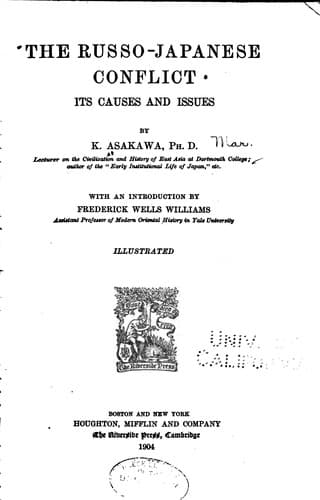
The Russo-Japanese Conflict: Its Causes and IssuesAsakawa, Kan'ichi
History
The Russo-Japanese Conflict: Its Causes and Issues
Asakawa, Kan'ichi
Russo-Japanese War, 1904-1905; Russo-Japanese War, 1904-1905 -- Causes
intensified, if at all, by the further explanation by Count Lamsdorff on
February 6, that “when it came to the final and complete evacuation of
Manchuria, the Russian Government would be obliged to obtain from the
central Government of China an effective guarantee against the
recurrence of the recent attack on her frontier and the destruction of
her railway, but had no intention of seeking this guarantee in any
acquisition of territory or of an actual or virtual protectorate over
Manchuria, the object being to simply guarantee the faithful observance
in the future by China of the terms of the agreement [agreement between
the Chinese Government and the Russo-Chinese Bank, September 28, 1896?],
which she had been unable to fulfill during the disturbances. The terms
of this guarantee might possibly form the subject of conversation here
between Count Lamsdorff and the Chinese Minister, or be left for
discussion at Peking.”[339] A month before this official statement of
Russia reached the London Government, the latter heard from the Japanese
Minister, Baron Hayashi, that Russia and China had already made at St.
Petersburg some arrangement regarding Manchuria,[340] evidently referred
to by Count Lamsdorff in the quoted passage as “an effective guarantee.”
-----
Footnote 318:
The Court had fled toward Ta-yuen-Fu before the allied troops reached
Peking, and thence started toward Si-ngan-Fu, the capital of many a
historic dynasty, on October 1.
Footnote 319:
Russia had early advocated accepting Li as plenipotentiary, while
other Powers were still skeptical of the nature of his credentials.
See _China, No. 1 (1901)_, Nos. 254, 356, 368, 371, 398, 401; _China,
No. 5 (1901)_, Nos. 5, 31, 111, 112, 128, 216; U. S. 56th Congress, 2d
Session, _House Documents_, vol. i. pp. 203–204, 305–306, 381–382. It
was not till September 20 that Li entered Peking. Prince Ching had
arrived there September 3. The appointment of the Prince as a
plenipotentiary is said to have been partly due to Japanese influence.
Footnote 320:
_Documents diplomatiques: Chine, 1899–1900_, No. 327 (p. 174). Also
see _China, No. 5 (1901)_, pp. 5, 46, 53–54.
Footnote 321:
_China, No. 5 (1901)_, No. 17.
Footnote 322:
For the Japanese amendments, see _ibid._, Nos. 60, 151, 178.
Footnote 323:
Russia openly declared in her _Messager Officiel_ of March 24 (April
6), 1901, that the Russian views regarding the settlement of the
trouble in North China, as distinguished from Manchuria, had “served
the French Government as a basis for the elaboration” of the latter’s
propositions.—_China, No. 2 (1904)_, pp. 20–21.
Footnote 324:
November 5.—_China, No. 5 (1901)_, No. 117.
Footnote 325:
November 28.—_Ibid._, Nos. 178 and 198.
Footnote 326:
_China, No. 2 (1904)_, p. 21.
Footnote 327:
_Ibid._, p. 20.
Footnote 328:
Public-domain text, read in full here on John Shaqi.
Reviews
Reviews
No reviews yet
Be the first to share your thoughts on this work.
Elsewhere in the archive
Join the Discussion
Join the discussion
Sign in to leave a comment or review.
Sign InorCreate an account