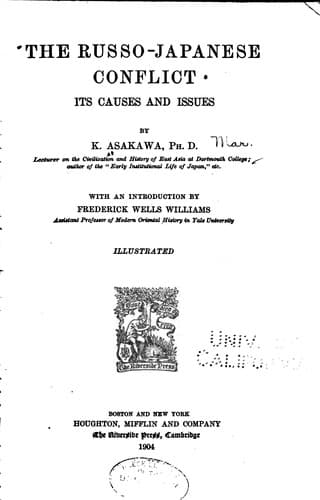
The Russo-Japanese Conflict: Its Causes and IssuesAsakawa, Kan'ichi
History
The Russo-Japanese Conflict: Its Causes and Issues
Asakawa, Kan'ichi
Russo-Japanese War, 1904-1905; Russo-Japanese War, 1904-1905 -- Causes
a remark was regarded as a radical departure from the diplomatic
amenities between the Powers. Russia might without offense have pleaded
her reasons against the opinion of the majority, and then dissented at
the final vote, but it was considered a very different matter for her to
declare, in such a way as would openly place the other Powers in a false
light in the eyes of the Chinese, that she had nothing to do with the
question. The act, it must be said, came with particular ill grace at a
time when Russia was believed to be negotiating an agreement with China,
separately, and in terms manifestly contrary to the fundamental
principles upon which the Powers’ diplomacy at Peking was based.[363] A
joint vote demanding the punishment of the officials had to be presented
to the Chinese commissioners, on April 1, with the signatures of all but
M. de Giers.[364]
Directly in connection with this episode may be considered the fact
that, at the urgent request of China, Russia had in the mean time
somewhat modified the terms of her proposition, about March 19, so as,
in brief, to allow China to station troops in Manchuria for the
protection of the Russian railways and the prevention of fresh
disorders, their numbers and posts to be determined by consulting
Russia; and also to prohibit the importation of arms and ammunition only
in accordance with the agreement with the Powers (Article 4); to exclude
cannon from the armament of the Chinese mounted and foot police forces
in Manchuria only until peace is restored (Article 5); to retain the
administrative autonomy of Kin-chow (Article 7); and to arrange with the
Company the matter of indemnities in accordance with the general method
used by the Powers (Article 10). The eighth Article was altered so as to
apply the exclusive measure only to Manchuria, and the sixth was
entirely expunged.[365] Simultaneously with these modifications in
China’s favor, Russia seemed to have suddenly increased her pressure
upon the helpless Court of China. Count Lamsdorff was reported[366] to
have declared to Yang-yu that he would withdraw the draft and break off
negotiations if it were not signed within two weeks from March 13. An
Imperial Decree, dated March 20, and addressed to Sir Chin-chen
Lo-fêng-luh, the Chinese Minister at London, stated: “The Manchurian
Agreement has now been amended, but the stipulated time within which the
Agreement is to be signed will soon expire. As the Marquess of Lansdowne
has advised us to wait for his reply [to the Edict of February 28], we
have now to command Lo-fêng-luh to ask Lord Lansdowne either (1) to help
us out of the difficulty, or (2) to ask Russia to extend the time
stipulated for signing the Agreement. Otherwise, we, being placed in
great difficulty, will be unable to oppose Russia any further. An
immediate reply is expected. Respect this.”[367] On the next day came an
urgent appeal from Yang-tsze Viceroys and Taotai Sheng, who requested,
Public-domain text, read in full here on John Shaqi.
Reviews
Reviews
No reviews yet
Be the first to share your thoughts on this work.
Elsewhere in the archive
Join the Discussion
Join the discussion
Sign in to leave a comment or review.
Sign InorCreate an account