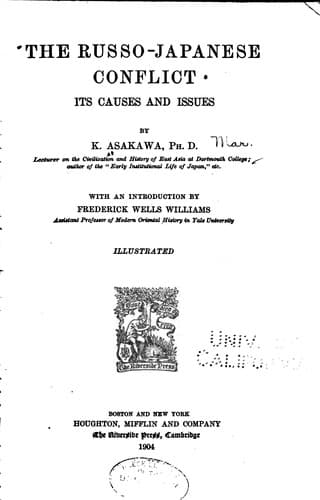
The Russo-Japanese Conflict: Its Causes and IssuesAsakawa, Kan'ichi
History
The Russo-Japanese Conflict: Its Causes and Issues
Asakawa, Kan'ichi
Russo-Japanese War, 1904-1905; Russo-Japanese War, 1904-1905 -- Causes
under instructions from the Chinese Government, that Great Britain, the
United States, Germany, and Japan intervene to obtain an extension of
time with a view to the modification of the Articles regarding civil
administration in the Chinese garrisons in Manchuria, the exclusive
trading rights demanded by the Russians, and the proposed railway to the
Wall.[368] Six days later, on March 27, the two-week period expired, and
the Chinese Court, which still sojourned at Si-ngan in the Shen-si
Province, telegraphed to Sir Chin-chen Lo-fêng-luh, as follows: “We have
followed the advice of Lord Lansdowne, in not giving our authority to
sign the Manchurian Agreement. In your telegrams of the 20th[369] and
23d[370] instant, you have assured us of the moral support of England if
we followed her advice. Our Plenipotentiaries, Prince Ching and Viceroy
Li, report that Russia will now permanently occupy Manchuria, and that
the collective negotiations will have to be suspended. The Court feels
great anxiety about this matter. As Manchuria is the cradle of the
present dynasty, how could China tolerate a permanent occupation of that
region? We now apply for the positive assistance of England in bringing
about a satisfactory settlement between China and Russia, in order to
avoid a rupture with that Power, which could not fail to be detrimental
to the interests of China and the treaty Powers. Please lay the contents
of the telegram before Lord Lansdowne and request an immediate
reply.”[371] It is possible that these messages were simultaneously
repeated to some or all of the rest of the four Powers, and, if so, it
becomes tenable that, but for the protests of the Powers, Li Hung-chang
might have signed the agreement. Nor can it be denied that, even after
their final refusal to accept the Russian proposals, the Chinese
officials clearly apprehended that, failing the positive support of the
Powers, Manchuria would be _permanently_ occupied by the northern Power.
It is, of course, uncertain, and perhaps also immaterial, whether they
had voluntarily reached that conclusion, or whether the Russians had led
them to the belief by threats.
Public-domain text, read in full here on John Shaqi.
Reviews
Reviews
No reviews yet
Be the first to share your thoughts on this work.
Elsewhere in the archive
Join the Discussion
Join the discussion
Sign in to leave a comment or review.
Sign InorCreate an account