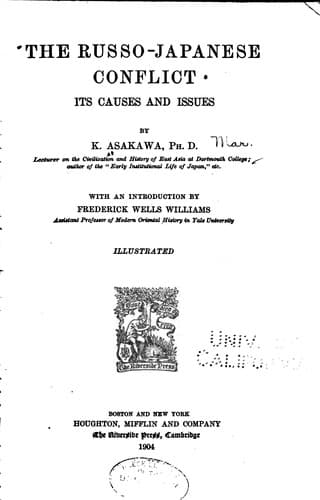
The Russo-Japanese Conflict: Its Causes and IssuesAsakawa, Kan'ichi
History
The Russo-Japanese Conflict: Its Causes and Issues
Asakawa, Kan'ichi
Russo-Japanese War, 1904-1905; Russo-Japanese War, 1904-1905 -- Causes
contradiction of the assurances which, under the orders of His Majesty
the Emperor, I have had occasion to give heretofore in regard to the
principles which invariably direct the policy of Russia.”[394] It should
be noted here that Count Lamsdorff’s statement, while it refers to the
Agreement with the Bank, which he supported, contains no reference to
the Convention proposed by the Russian Government.
Negotiations lagged, China probably declining to sign under the
remonstrances of Great Britain, the United States, and Japan. On March
2, Prince Ching showed Mr. Conger a draft of his new counter-proposals,
which Japan was said to have wholly, and Great Britain in the main,
approved.[395] These proposals are interesting for their practical
identity, save a slight difference,[396] with the final Russo-Chinese
Convention of April 8, 1902, which will be fully treated in a subsequent
chapter. This fact is a conclusive evidence that after March, Russia
suddenly accepted nearly all of the counter-proposals made by China.
This abrupt condescension on the part of Russia is supposed to have been
partly due to an important event which had recently taken place in the
diplomatic world—the conclusion of the Anglo-Japanese Agreement signed
at London on January 30, 1902, and simultaneously announced in
Parliament and the Imperial Diet of Tokio on February 12.
-----
Footnote 379:
The _Kokumin_, May 19, 1901.
Footnote 380:
_China, No. 2 (1904)_, No. 40. In No. 42 (August 21), Sir Ernest
gives, in three parallel columns, the original terms proposed by
Russia in February, the alterations of March, and the proposals now
made in August. The last two are nearly identical.
Footnote 381:
_China, No. 2 (1904)_, No. 41 (August 16).
Footnote 382:
See Mayers, pp. 283–318; or the Blue Book, _Treaty Series_, No. 17,
1902; _Final Protocol between the Foreign Powers and China for the
Resumption of Friendly Relations_.
Footnote 383:
_Tokushu Jōyaku_, p. 266.
Footnote 384:
See the summary of Li’s highly interesting letter of September 30,
which has just appeared in the London _Times_ for October 12, 1904, p.
6.
Footnote 385:
_Tokushu Jōyaku_, pp. 266–267; The _Kokumin_, November 2, pp. 23, 30,
190–191.
Footnote 386:
The U. S. 57th Congress, 2d Session, _House Documents_, vol. i. p.
272.
Footnote 387:
The U. S. 57th Congress, 2d Session, _House Documents_, vol. i. p.
271. Compare a version in _Tokushu Jōyaku_, pp. 266–267.
Footnote 388:
The U. S. 57th Congress, 2d Session, _House Documents_, vol. i. p.
272.
Footnote 389:
The U. S. 57th Congress, 2d Session, _House Documents_, vol. i. pp.
273–274.
Footnote 390:
_Ibid._, pp. 273–274 (Conger to Hay).
Footnote 391:
The U. S. 57th Congress, 2d Session, _House Documents_, vol. i. pp.
926–928.
Footnote 392:
The italics in the quotation are the author’s.
Footnote 393:
Public-domain text, read in full here on John Shaqi.
Reviews
Reviews
No reviews yet
Be the first to share your thoughts on this work.
Elsewhere in the archive
Join the Discussion
Join the discussion
Sign in to leave a comment or review.
Sign InorCreate an account