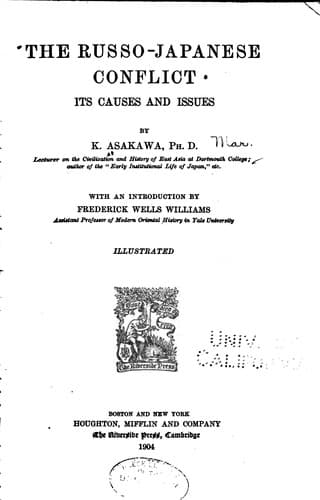
The Russo-Japanese Conflict: Its Causes and IssuesAsakawa, Kan'ichi
History
The Russo-Japanese Conflict: Its Causes and Issues
Asakawa, Kan'ichi
Russo-Japanese War, 1904-1905; Russo-Japanese War, 1904-1905 -- Causes
Observe how powerfully Russia applies this argument. On February 4, M.
Lessar said that Russia was merely asking privileges in Manchuria
similar to those granted to Germany in Shan-tung.—The U. S. 57th
Congress, 2d Session, _House Documents_, vol. i. p. 274. Russia, if
she would, could with a certain amount of impunity inquire of Great
Britain and other Powers how it was that they allowed Germany to
acquire her apparently exclusive rights in Shan-tung, and now objected
to Russia’s following her example only on a larger scale.
Footnote 394:
The U. S. 57th Congress, 2d Session, _House Documents_, vol. i. p.
929.
Footnote 395:
_Ibid._, pp. 277–279.
Footnote 396:
I. e., the draft of March limited the period of evacuation to one
year, instead of a year and a half, as in the convention of April.
CHAPTER XII
THE ANGLO-JAPANESE AGREEMENT AND THE RUSSO-FRENCH DECLARATION
The details of the negotiations preliminary to the consummation of this
remarkable stroke of diplomacy have not been made public, but we are in
possession of some salient facts from which successive steps leading up
to the final conclusion may be inferred with tolerable certainty. It is
well known that Great Britain, which had always occupied a predominant
place in the foreign relations of Japan, had persistently opposed the
latter’s ardent wish and continual struggle to revise the humiliating
treaties which had, about 1858, been imposed by the Powers upon the weak
feudal Government of Yedo. In 1894, however, contrary to her past
policy, Great Britain led other Powers in according to Japan a cordial
recognition of the latter’s progress in various lines of her national
activity, and assenting to the revision of her treaties. During the war
with China in 1894–5, the British attitude was one of friendly
neutrality between the two Oriental Empires, but the events after the
conclusion of the war, especially the forced retrocession of the
Liao-tung Peninsula, closely followed by the tightening hold of the
Muscovites upon the Peking Court, seemed to have aroused the sympathy of
Great Britain with Japan, mingled probably with the fear of the loss of
some of her own predominant economic interests in China. From this time
on, the interests of the two Powers had been seen to coincide in the Far
East to an increasing degree, and the relations of their Governments had
steadily risen in cordiality.[397] At the rupture of the Boxer
insurrection in 1900, the Cabinet of Lord Salisbury manifested so much
faith in Japan as to request her immediately to dispatch large forces to
the relief of the besieged Legations at Peking, Great Britain going even
so far as to engage to undertake the necessary financial
responsibilities of the proposed expedition.[398] Both during the
campaign and throughout the negotiation for peace, the two Powers, as
well as the United States, conducted themselves together, as is apparent
Public-domain text, read in full here on John Shaqi.
Reviews
Reviews
No reviews yet
Be the first to share your thoughts on this work.
Elsewhere in the archive
Join the Discussion
Join the discussion
Sign in to leave a comment or review.
Sign InorCreate an account