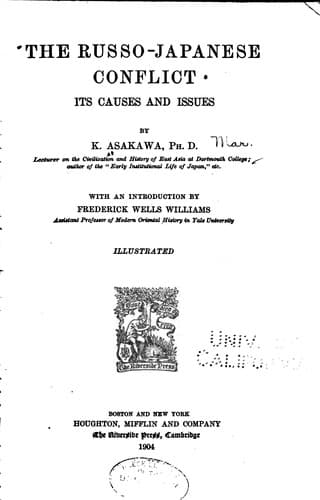
The Russo-Japanese Conflict: Its Causes and IssuesAsakawa, Kan'ichi
History
The Russo-Japanese Conflict: Its Causes and Issues
Asakawa, Kan'ichi
Russo-Japanese War, 1904-1905; Russo-Japanese War, 1904-1905 -- Causes
from our foregoing discussion, in perfect harmony.[399] The common
danger in Manchuria still further cemented their friendship. All this
cordial relation, spontaneous as it was, would not, however, account for
the formation of a definite alliance between the two Governments. It
seems at least probable that the Anglo-German Agreement of October,
1900, as much by the importance of some of its principles as by its very
inefficiency, served as a natural step toward a more wholesome
alliance.[400] In this new direction, Great Britain is said to have
taken the initiative. This supposition will appear not improbable when
it is considered that her immense interests in China, which had begun to
be eclipsed by other Powers, would be best secured and promoted by the
maintenance of the integrity of China and the open door in her market,
and that this object could not be better assured than by an alliance
with the strongest Eastern Power, whose fast growing interests in the
neighboring lands were in a large measure identical with hers.
Suggestions for such an agreement are known to have been made by Great
Britain to Japan under the Itō Cabinet in April, 1901, and again under
the present Katsura Cabinet in July, but it was not till October of that
year that definite negotiations were opened by Japan. The Premier,
Viscount Katsura, seems to have ascertained in December that the elder
statesmen of the Empire were in hearty accord with the agreement toward
which the negotiations had pointed.[401] At this stage of the
negotiations, also, there had developed other circumstances under which
the “splendid” isolation of Great Britain appeared less tenable than
before. Half a year after the Anglo-German Agreement was rendered
valueless by the declarations of Herr von Bülow, the Czar paid a
significant visit, in September, not only to France, but also to
Germany. The ebullition of friendly sentiments between the heads of the
States was not less effervescent at Danzig than at Dunkirk. The
Russo-Chinese Bank presently floated a loan of 80,000,000 marks at
Berlin, thus insuring to that extent the interests of the Germans in
Russian success in the East. At the same time the situation in Manchuria
had been growing more serious than before, while Germany had seemed no
longer inclined to join Great Britain in the latter’s protests against
the menacing conduct of Russia. Grave as was the danger to the political
and commercial prestige of Great Britain in the East, her hands were
still closely tied by the vexatious South African question. If there
ever was need of an agreement with the rising Power of the Orient, it
had probably been never more keenly felt by the British Government than
in the last part of the year 1901. Side by side with these favorable
circumstances for an understanding, the student should not for a moment
lose from sight two fundamental conditions which drew together, not only
the Governments, but also the people, of Great Britain and Japan with
Public-domain text, read in full here on John Shaqi.
Reviews
Reviews
No reviews yet
Be the first to share your thoughts on this work.
Elsewhere in the archive
Join the Discussion
Join the discussion
Sign in to leave a comment or review.
Sign InorCreate an account