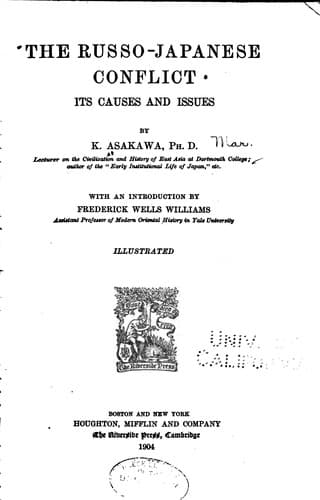
The Russo-Japanese Conflict: Its Causes and IssuesAsakawa, Kan'ichi
History
The Russo-Japanese Conflict: Its Causes and Issues
Asakawa, Kan'ichi
Russo-Japanese War, 1904-1905; Russo-Japanese War, 1904-1905 -- Causes
mutual attraction. One was sentimental: each of the two nations found in
the other, though in different ways from one another, something of a
counterpart of its geographical position, its material needs and
aspirations, and the energy and enterprise of its individual members.
This mutual sympathy was largely intensified by, not, indeed, so much
the identity of their interests in the East, as the common principles
under which these interests would be best protected—the independence and
strength of China and Korea, and the equal opportunity therein for the
economic enterprise of all nations.
[Illustration:
COUNT KATSURA
_Premier of Japan_
]
The final outcome of the Anglo-Japanese negotiations was a remarkable
product, the like of which is seldom seen in history, especially when it
is considered that it united reciprocally two nations widely apart in
race, religion, and history, one of which had rarely in time of peace
entered into a regular alliance even with a European Power.[402] The
most striking, as well as the most important for our study, must be
regarded the entirely fair and open principles to which the Agreement
gave clear expression. These remarks may not be better substantiated
than by quoting the exact words of the document itself, and of the
dispatch inclosing the Agreement from Lord Lansdowne to Sir Claude
MacDonald, the British Minister at Tokio, which read as follows:—
“The Governments of Great Britain and Japan, actuated solely by a
desire to maintain the _status quo_ and general peace in the extreme
East, being moreover specially interested in maintaining the
independence and territorial integrity of the Empire of China and
the Empire of Korea, and in securing equal opportunities in those
countries for the commerce and industry of all nations, hereby agree
as follows:—
“ARTICLE I. The High Contracting Parties having mutually recognized
the independence of China and Korea, declare themselves to be
entirely uninfluenced by any aggressive tendencies in either
country. Having in view, however, their special interests, of which
those of Great Britain relate principally to China, while Japan, in
addition to the interests which she possesses in China, is
interested in a peculiar degree, politically as well as commercially
and industrially, in Korea, the High Contracting Parties recognize
that it will be admissible for either of them to take such measures
as may be indispensable in order to safeguard those interests if
threatened either by the aggressive action of any other Power, or by
disturbances arising in China or Korea, and necessitating the
intervention of either of the High Contracting Parties for the
protection of the lives and property of its subjects.
Public-domain text, read in full here on John Shaqi.
Reviews
Reviews
No reviews yet
Be the first to share your thoughts on this work.
Elsewhere in the archive
Join the Discussion
Join the discussion
Sign in to leave a comment or review.
Sign InorCreate an account