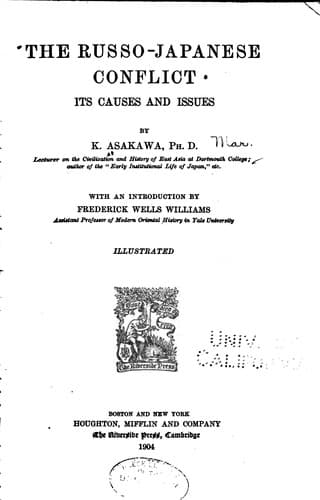
The Russo-Japanese Conflict: Its Causes and IssuesAsakawa, Kan'ichi
History
The Russo-Japanese Conflict: Its Causes and Issues
Asakawa, Kan'ichi
Russo-Japanese War, 1904-1905; Russo-Japanese War, 1904-1905 -- Causes
“ARTICLE II. If either Great Britain or Japan, in the defense of
their respective interests as above described, should become
involved in war with another Power, the other High Contracting Party
will maintain a strict neutrality, and use its efforts to prevent
other Powers from joining in hostilities against its ally.
“ARTICLE III. If in the above event, any other Power or Powers
should join in hostilities against that ally, the other High
Contracting Party will come to its assistance, and will conduct war
in common, and will make peace in mutual agreement with it.
“ARTICLE IV. The High Contracting Parties agree that neither of them
will, without consulting the other, enter into separate arrangements
with another Power to the prejudice of the interests above
described.
“ARTICLE V. Whenever, in the opinion of either Great Britain or
Japan, the above-mentioned interests are in jeopardy, the two
Governments will communicate with one another fully and frankly.
“ARTICLE VI. The present Agreement shall come into effect
immediately after the date of its signature, and remain in force for
five years from that date.
“In case neither of the High Contracting Parties should have
notified twelve months before the expiration of the said five years
the intention of terminating it, it shall remain binding until the
expiration of one year from the day on which either of the High
Contracting Parties shall have denounced it. But if, when the date
fixed for its expiration arrives, either ally is actually engaged in
war, the alliance shall, _ipso facto_, continue until peace is
concluded.
“In faith whereof the Undersigned, duly authorized by their
respective Governments, have signed this Agreement, and have affixed
thereto their seals.
“Done in duplicate at London, the 30th January, 1902.
“LANSDOWNE,
_His Britannic Majesty’s Principal Secretary of State for Foreign
Affairs._
“HAYASHI,
_Envoy Extraordinary and Minister Plenipotentiary of His Majesty
the Emperor of Japan at the Court of St. James.”_[403]
“FOREIGN OFFICE, January 30, 1902.
“SIR CLAUDE MACDONALD [the British Minister at Tokio]:
“I have signed to-day, with the Japanese Minister, an Agreement
between Great Britain and Japan, of which a copy is inclosed in this
dispatch.
“This Agreement may be regarded as the outcome of the events which
have taken place during the past two years in the Far East, and of
the part taken by Great Britain and Japan in dealing with them.
“Throughout the troubles and complications which arose in China
consequent upon the Boxer outbreak and the attack upon the Peking
Legations, the two Powers have been in close and uninterrupted
communication, and have been actuated by similar views.
Public-domain text, read in full here on John Shaqi.
Reviews
Reviews
No reviews yet
Be the first to share your thoughts on this work.
Elsewhere in the archive
Join the Discussion
Join the discussion
Sign in to leave a comment or review.
Sign InorCreate an account