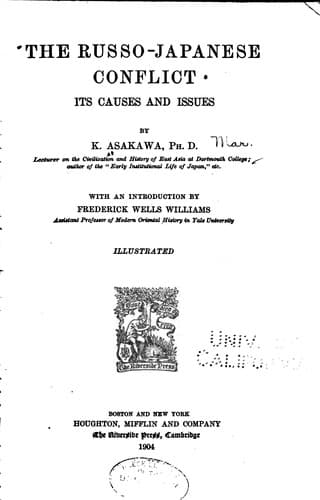
The Russo-Japanese Conflict: Its Causes and IssuesAsakawa, Kan'ichi
History
The Russo-Japanese Conflict: Its Causes and Issues
Asakawa, Kan'ichi
Russo-Japanese War, 1904-1905; Russo-Japanese War, 1904-1905 -- Causes
“We have each of us desired that the integrity and independence of
the Chinese Empire should be preserved, that there should be no
disturbance of the territorial _status quo_ either in China or in
the adjoining regions, that all nations should, within those
regions, as well as within the limits of the Chinese Empire, be
afforded equal opportunities for the development of their commerce
and industry, and that peace should not only be restored, but
should, for the future, be maintained.
“From the frequent exchanges of view which have taken place between
the two Governments, and from the discovery that their Far Eastern
policy was identical, it has resulted that each side has expressed
the desire that their common policy should find expression in an
international contract of binding validity.
“We have thought it desirable to record in the Preamble of that
instrument the main objects of our common policy in the Far East to
which I have already referred, and in the first Article we join in
entirely disclaiming any aggressive tendencies either in China or
Korea. We have, however, thought it necessary also to place on
record the view entertained by both the High Contracting Parties,
that should their interests as above described be endangered, it
will be admissible for either of them to take such measures as may
be indispensable in order to safeguard their interests, and words
have been added which will render it clear that such precautionary
measures might become necessary and might be legitimately taken, not
only in the case of aggressive action or of an actual attack of some
other Power, but in the event of disturbances arising of a character
to necessitate the intervention of either of the High Contracting
Parties for the protection of the lives and property of its
subjects.
“The principal obligations undertaken mutually by the High
Contracting Parties are those of maintaining a strict neutrality in
the event of either of them becoming involved in war, and of coming
to one another’s assistance in the event of either of them being
confronted by the opposition of more than one hostile Power. Under
the remaining provisions of the Agreement, the High Contracting
Parties undertake that neither of them will, without consultation
with the other, enter into separate arrangements with another Power
to the prejudice of the interests described in the Agreement, and
that whenever those interests are in jeopardy, they will communicate
with one another fully and frankly.
“The concluding Article has reference to the duration of the
Agreement which, after five years, is terminable by either of the
High Contracting Parties at one year’s notice.
Public-domain text, read in full here on John Shaqi.
Reviews
Reviews
No reviews yet
Be the first to share your thoughts on this work.
Elsewhere in the archive
Join the Discussion
Join the discussion
Sign in to leave a comment or review.
Sign InorCreate an account