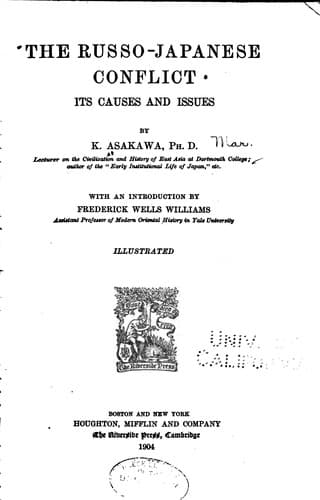
The Russo-Japanese Conflict: Its Causes and IssuesAsakawa, Kan'ichi
History
The Russo-Japanese Conflict: Its Causes and Issues
Asakawa, Kan'ichi
Russo-Japanese War, 1904-1905; Russo-Japanese War, 1904-1905 -- Causes
“His Majesty’s Government had been largely influenced in their
decision to enter into this important contract by the conviction
that it contains no provisions which can be regarded as an
indication of aggressive or self-seeking tendencies in the regions
to which it applies. It has been concluded purely as a measure of
precaution, to be invoked, should occasion arise, in the defence of
important British interests. It in no way threatens the present
position or the legitimate interests of other Powers. On the
contrary, that part of it which renders either of the High
Contracting Parties liable to be called upon by the other for
assistance can operate only when one of the allies has found himself
obliged to go to war in defence of interests which are common to
both, when the circumstances in which he has taken this step are
such as to establish that the quarrel has not been of his own
seeking, and when, being engaged in his own defence, he finds
himself threatened, not only by a single Power, but by a hostile
coalition.
“His Majesty’s Government trust that the Agreement may be found of
mutual advantage to the two countries, that it will make for the
preservation of peace, and that, should peace be unfortunately
broken, it will have the effect of restricting the area of
hostilities.
“I am, etc.,
“LANSDOWNE.”[404]
The singular nature of these documents stands out so clearly on their
face that it hardly needs a special reference. Not only has Manchuria at
last been clearly interpreted by both Powers as lying within the scope
of the Agreement, but it is explicitly admitted therein that Japan
possesses extensive interests in the Korean peninsula, which is for that
reason included in the sphere within which the contracting parties
unequivocally disavow aggressive tendencies. Nor does this sum up all
the difference between this and the Anglo-German Agreement, for, while
in the latter the denial of the parties’ aggressive designs was limited
to the period of the Boxer complication, and, moreover, coupled with a
reservation amounting to the recognition of the theory of readjusting
the balance between the Powers at the expense of China, the new alliance
unconditionally upholds the independence of China and Korea, and any
measure, either peaceful or warlike, taken by either party to safeguard
its interests, if they are in any way threatened, would by no means
alter its devotion to the principles of the territorial integrity of the
Chinese and Korean Empires and of the open door in those countries. The
alliance exists solely for the purpose of effectively safe-guarding the
interests already acquired by the two Powers on the common ground, and
it is implied in an unmistakable manner that those interests may best be
maintained by the total abstention, in any event, from all aggressive or
Public-domain text, read in full here on John Shaqi.
Reviews
Reviews
No reviews yet
Be the first to share your thoughts on this work.
Elsewhere in the archive
Join the Discussion
Join the discussion
Sign in to leave a comment or review.
Sign InorCreate an account