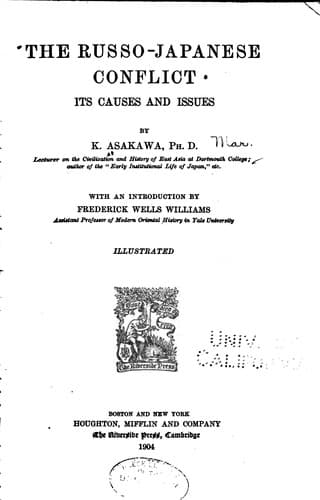
The Russo-Japanese Conflict: Its Causes and IssuesAsakawa, Kan'ichi
History
The Russo-Japanese Conflict: Its Causes and Issues
Asakawa, Kan'ichi
Russo-Japanese War, 1904-1905; Russo-Japanese War, 1904-1905 -- Causes
“The Chinese Government, on its side, confirms all the obligations
it has previously undertaken toward Russia, and particularly the
provisions of the 1896 Agreement, which must serve as a basis for
the friendly relations of the neighboring Empires. By this defensive
Agreement, Russia undertook in 1896 to maintain the principle of the
independence and integrity of China, who, on her side, gave Russia
the right to construct a line through Manchuria and to enjoy the
material privileges which are directly connected with the above
undertaking.
“After the instructive events of the last two years, it is possible
to hope for the complete pacification of the Far East, and the
development of friendly relations with China in the interests of the
two Empires. But, undoubtedly, if the Chinese Government, in spite
of their positive assurances, should, on any pretext, violate the
above conditions, the Imperial Government would no longer consider
itself bound by the provisions of the Manchurian Agreement, nor by
its declarations on this subject, and would have to decline to take
the responsibility for all the consequences which might ensue.”[414]
The comparatively mild terms of this Convention may well be pointed
out.[415] Except in the negative reservations of Article 4, there is
found here no provision for the exclusive control by the Russians of the
mining and railway enterprises either in or out of Manchuria. On the
contrary, the sovereign rights in Manchuria, including those respecting
the disposition of military forces, will in eighteen months be almost
completely restored to the Chinese Government, and the entire agreement
will become operative from the very day of its signature. The Convention
seemed to confirm the avowed intention of Russia to love peace and
respect the integrity of China. It is not strange that Prince Ching
personally thanked Great Britain, Japan, and the United States for the
valuable support they had rendered China in the negotiations which had
terminated in the conclusion of this instrument.[416]
Public-domain text, read in full here on John Shaqi.
Reviews
Reviews
No reviews yet
Be the first to share your thoughts on this work.
Elsewhere in the archive
Join the Discussion
Join the discussion
Sign in to leave a comment or review.
Sign InorCreate an account