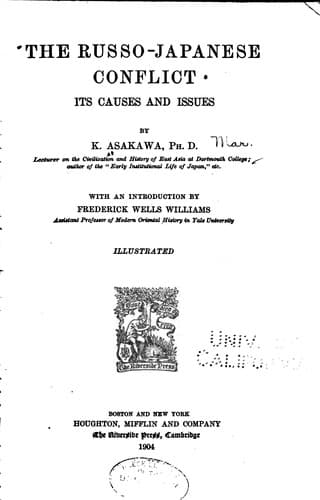
The Russo-Japanese Conflict: Its Causes and IssuesAsakawa, Kan'ichi
History
The Russo-Japanese Conflict: Its Causes and Issues
Asakawa, Kan'ichi
Russo-Japanese War, 1904-1905; Russo-Japanese War, 1904-1905 -- Causes
If, however, the subsequent conduct of Russia in Manchuria has appeared
to contradict the tenor of the Agreement, it is only necessary to point
out how elastic and expansive its terms are. Paragraph 5, Article 2, of
the Bank Agreement of September 8, 1896, imposing upon the Chinese
Government the duty to protect the Manchurian Railway and the persons
employed in it, is not only reinforced but also expanded so as to make
it incumbent upon China “to secure within the boundaries of Manchuria
the safety of all Russian subjects in general and the undertakings
established by them.” Unless Manchuria is considered a territory
distinct from the rest of the Chinese Empire, no Russians or other
foreigners have the right to reside in the interior save in the treaty
posts. Yet the Chinese Government is held responsible for the security
of the Russians and their enterprises in Manchuria, which is regarded
virtually as a Russian colony, into which immigrants from Siberia and
European Russia have been sent with wonderful rapidity. Nor does this
additional obligation on the part of China any longer bind her to a
private company called the Russo-Chinese Bank, but henceforth to the
Government of the Czar. The discharge of so onerous a duty is made a
condition for the Russian evacuation of Manchuria.
It is not generally known that this condition, otherwise so difficult,
was practically impossible so long as the presence of the Russian forces
kept the Chinese troops greatly reduced in number. The apprehended
disorder must come, as it always has done, and as none knew better than
the Russians, from the groups of unoccupied men, the so-called mounted
bandits (_ma tseh_), who infested the Provinces of Sheng-king and Kirin,
where they sided with whatever power suited their fancy and interest,
exercised their own law, and in one way or another kept the country in a
state of great instability. It should be noted that they were either
disbanded soldiers or the possible candidates for the Chinese troops to
be levied to safeguard Manchuria—for military life in China seldom
attracts peaceful citizens. So long as the presence of the Russian
forces rendered the regular service of the outlaws in the Chinese army
unnecessary, their means of subsistence would be derived less often from
a settled agricultural life than from plundering. Between March, 1902,
and August, 1903, a Russian officer successfully enlisted the service of
some 450 of these marauders, and employed them in the timber work which
the Russians secured in Eastern Manchuria in the name of one of the
chiefs of the bandits.[417] Before and after this period, however, the
Russian officers continually reported sanguinary conflicts with the
robbers, the fear of whom has seemed to constitute the main
justification for the steady progress of the Russian measures of
tightening a hold upon Manchuria.[418] Side by side with this grave
situation, we should also observe that the Convention provided that,
Public-domain text, read in full here on John Shaqi.
Reviews
Reviews
No reviews yet
Be the first to share your thoughts on this work.
Elsewhere in the archive
Join the Discussion
Join the discussion
Sign in to leave a comment or review.
Sign InorCreate an account