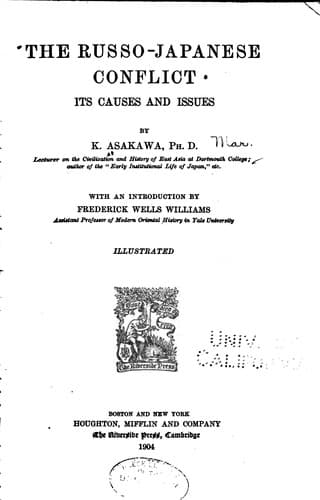
The Russo-Japanese Conflict: Its Causes and IssuesAsakawa, Kan'ichi
History
The Russo-Japanese Conflict: Its Causes and Issues
Asakawa, Kan'ichi
Russo-Japanese War, 1904-1905; Russo-Japanese War, 1904-1905 -- Causes
even after the evacuation, if an evacuation were possible, the numbers
and the stations of the Chinese troops, upon whom the duty of protecting
the rapidly increasing Russian subjects and properties in Manchuria
would devolve, should always be made known to Russia, so that
unnecessarily large forces should not be stationed. Russia would judge
whether the Chinese forces were excessive, and exert her influence to
keep them in reduced numbers,[419] while, at the same time, their
capacity as well for receiving the banditti into their ranks as for
affording protection to the Russian life and property would, to say the
least, soon reach its limits. Thus the explicit terms of the Convention
were constructed so as to be greatly neutralized, as it would seem, by
what was implied and could only be inferred by analysis. In the light of
these considerations may be seen the statement that, “undoubtedly, if
the Chinese Government, in spite of their positive assurances, should,
on any pretext, violate the above conditions [i. e., of the Convention],
the Imperial Government would no longer consider itself bound by the
provisions of the Manchurian Agreement, nor by its declarations on this
subject, and would have to decline to take the responsibility for all
the consequences which might ensue,”[420]—a reservation which Count
Lamsdorff considered “a very necessary one.”[421] In the same light,
also, one may read the statement made by Sir Ernest Satow to Prince
Ching, that “the Convention did not appear to His Majesty’s Government
to be entirely satisfactory,”[422] and also the pungent remark of Lord
Lansdowne to M. de Staal, that there were several points in the
Agreement which had caused much criticism in England, particularly those
provisions which limited China’s right to dispose of her own military
forces and to construct railway extensions within her own territory. “I
did not, however,” adds the Marquess, “desire to examine these
provisions too microscopically, and I shared his [M. de Staal’s] hope
that the Agreement would be loyally and considerately interpreted on
both sides, and that the evacuation of the province would be completed
within the appointed time.”[423]
Public-domain text, read in full here on John Shaqi.
Reviews
Reviews
No reviews yet
Be the first to share your thoughts on this work.
Elsewhere in the archive
Join the Discussion
Join the discussion
Sign in to leave a comment or review.
Sign InorCreate an account