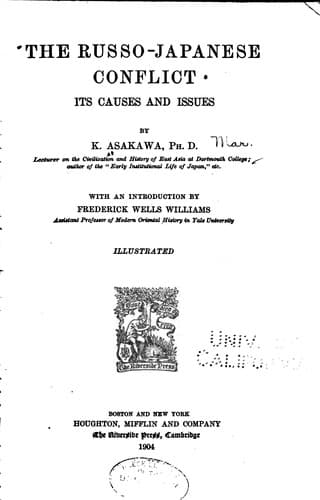
The Russo-Japanese Conflict: Its Causes and IssuesAsakawa, Kan'ichi
History
The Russo-Japanese Conflict: Its Causes and Issues
Asakawa, Kan'ichi
Russo-Japanese War, 1904-1905; Russo-Japanese War, 1904-1905 -- Causes
The last but not the least difficulty about the Agreement was its
absolute silence regarding the so-called “railway guards,” organized
ostensibly by the Eastern Chinese Railway Company, whose existence would
make the promised evacuation almost entirely nominal. It will be
remembered that, so far as the published agreements between China and
Russia are concerned, one fails to find any conventional ground for the
organization of the railway guards, save in Article 8 of the
Statutes—not a Russo-Chinese agreement, but purely Russian
statutes—published on December 11/13, 1896, which provided: “The
preservation of order and decorum on the lands assigned to the railway
and its appurtenances should be confined to the _police agents_
appointed by the Company. The Company should draw up and establish
police regulations.”[424] This right of Russia to police the railway
lands seems to have been tacitly perpetuated by the present Convention
of 1902,[425] and, from this, it may perhaps be assumed that the Chinese
Government had some time before April 8, 1902, agreed to the statutory
rule of Russia which has just been quoted. However that may be, a
permission to establish a police force could scarcely justify the
organization of railway guards selected from the regular troops and
receiving a higher pay than the latter. Moreover, it still remains to be
officially declared that the numbers of the guards would not be
determined by Russia at will and without consulting China. These guards
seem to have numbered only 2000 or 3000 before the Manchurian campaign
of 1900, but in October of that year Mr. Charles Hardinge, the British
_Chargé d’Affaires_ at St. Petersburg, wrote to Lord Salisbury: “I learn
that active recruiting for this force is now in progress, and its
numbers are to be raised to 12,000 men under command of officers in the
regular army. Intrenched camps are also being constructed at all the
strategic positions along the line.”[426] Then, on the eve of the
termination of the first period of evacuation in 1902, it was reported
by Consul Hosie: “I am credibly informed that the number of the military
guard of the Russian railways in Manchuria has been fixed at 30,000
men.”[427] Latterly, the name has been changed to the “frontier guards,”
which, after the beginning of the present war, were said to have been
made up of fifty-five mounted squadrons, fifty-five foot companies, and
six batteries of artillery, aggregating 25,000 men, instead of 30,000,
and guarding the railways in sections of thirty-three miles.[428] There
is no intention here to maintain the accuracy of these reports, or to
decide whether the numbers are adequate for the purpose in view, but one
would be tempted to think that the Russian Government made a regrettable
omission in the new Manchurian Agreement, when it made no reference to
the forces which were justified by no open contract with China, and,
theoretically speaking, were not incapable of an indefinite expansion.
-----
Public-domain text, read in full here on John Shaqi.
Reviews
Reviews
No reviews yet
Be the first to share your thoughts on this work.
Elsewhere in the archive
Join the Discussion
Join the discussion
Sign in to leave a comment or review.
Sign InorCreate an account