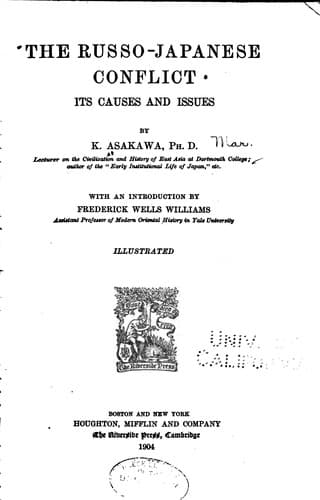
The Russo-Japanese Conflict: Its Causes and IssuesAsakawa, Kan'ichi
History
The Russo-Japanese Conflict: Its Causes and Issues
Asakawa, Kan'ichi
Russo-Japanese War, 1904-1905; Russo-Japanese War, 1904-1905 -- Causes
“3. ‘Engagement on the part of Russia not to impede the commercial
and industrial undertakings of Japan in Korea, nor to oppose any
measures taken for the purpose of protecting them, so long as such
measures do not infringe the stipulations of Article 1.
“4. ‘Recognition of the right of Japan to send, for the same
purpose, troops to Korea, with the knowledge of Russia, but their
number not to exceed that actually required, and with the engagement
on the part of Japan to recall such troops as soon as their mission
is accomplished.
“5. ‘Mutual engagement not to use any part of the territory of Korea
for strategical purposes, nor to undertake on the coasts of Korea
any military works capable of menacing the freedom of navigation in
the Straits of Korea.
“6. ‘Mutual engagement to consider that part of the territory of
Korea lying to the north of the thirty-ninth parallel as a neutral
zone into which neither of the contracting parties shall introduce
troops.
“7. ‘Recognition by Japan of Manchuria and its littoral as in all
respects outside her sphere of interest.
“8. ‘This Agreement to supersede all previous agreements between
Russia and Japan regarding Korea.[599]’”
In comparing this counter-note with the original note of Japan, it will
at once be seen that Russia seriously reduced Japan’s demands concerning
Korea by excluding her right of rendering advice and assistance to Korea
in the latter’s military affairs, and also by quietly suppressing the
important clause providing for mutual recognition of the principle of
the equal economic opportunity for all nations in Korea. Moreover,
Russia imposed upon Japan the following new conditions regarding Korea:
not to use any part of the territory for strategical purposes; not to
fortify the southern coast; and to consider the territory north of the
thirty-ninth parallel, covering nearly one third of the area of the
Empire, as neutral[600] between the two Powers. As regards Manchuria,
Russia silently discarded the two fundamental principles proposed by
Japan and often avowed by Russia herself, namely, China’s sovereignty
over it and the equal economic opportunity for all nations therein. On
the contrary, Russia requested Japan to declare Manchuria and its
littoral as outside of her sphere of interest. If the Power which
exchanged necessaries of life with Manchuria in fast growing quantities,
controlled more than ninety per cent. of the exports at Niu-chwang, and
numbered tens of thousands of its subjects residing in the Three
Provinces, should be required by Russia to declare itself uninterested
in Manchuria, the exclusive designs of Russia upon the territory would
seem to need no stronger proof. The general tenor of the note of October
3 was, thus, to exclude Manchuria from discussion, and, furthermore, to
restrict Japan’s influence in Korea. Russia explained that the question
of Manchuria rested between herself and China, and that she had no
Public-domain text, read in full here on John Shaqi.
Reviews
Reviews
No reviews yet
Be the first to share your thoughts on this work.
Elsewhere in the archive
Join the Discussion
Join the discussion
Sign in to leave a comment or review.
Sign InorCreate an account