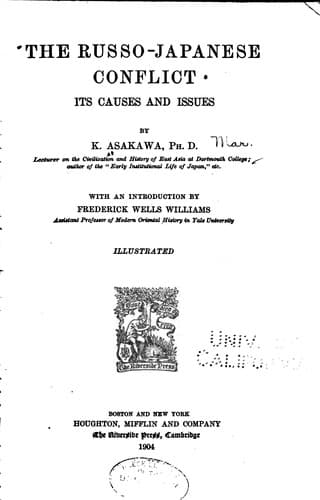
The Russo-Japanese Conflict: Its Causes and IssuesAsakawa, Kan'ichi
History
The Russo-Japanese Conflict: Its Causes and Issues
Asakawa, Kan'ichi
Russo-Japanese War, 1904-1905; Russo-Japanese War, 1904-1905 -- Causes
reason to make any arrangement about it with a third Power. To this,
Japan replied that she had asked from Russia no concession of any kind
in Manchuria, but merely requested her to recognize anew the principles
which she had voluntarily and repeatedly professed. Such a recognition,
Japan contended, was of vital interest to her, inasmuch as the Russian
occupation of Manchuria would continually threaten the independence of
Korea.[601] It was evident from Russia’s counter-note that there lay an
impassable gulf between the propositions of the two Powers, not only in
the actual terms under discussion, but also in the principles involved
in them, for, to all appearance, nothing could prove more clearly that
Russia was bent upon absorbing and closing up all Manchuria, as well as
marking out Northern Korea as an eventual sphere of her influence, and
that she was unwilling to recognize the profound and increasing common
interest of Japan and Manchuria, and the vital importance to the former
of the independence, strength, and development of Korea.
The date fixed in the Convention in April, 1902, for the final
evacuation of Manchuria arrived on October 8, 1903—five days after the
Russian counter-note was received by Japan, but the day came and passed
with no sign of the evacuation. On the contrary, the Russian Minister at
Peking was engaged, regardless of the negotiations at Tokio between his
Government and the Japanese, in urging Prince Ching to change the terms
of the Convention. Those who had been impressed by the manner and
contents of the Russian reply to the Japanese note did not fail to
observe in M. Lessar’s conduct at Peking another proof of the slight
weight which the Russians attached to the overtures of Japan at least
concerning Manchuria. For, if Russia succeeded in securing China’s
consent to her new demands regarding Manchuria, which in every way
transgressed the principles contained in the Japanese note, the
Manchurian negotiations between Russia and Japan would become
unnecessary. The Russian course of action at Tokio and Peking was thus
consistent in ignoring Japan’s vital interests in Manchuria, and,
therefore, was regarded as consistently insulting to Japan. The secret
of the situation seemed to be, as has been already suggested, that the
centre of gravity of Russian diplomacy in the East had largely shifted
from St. Petersburg to Port Arthur—from Count Lamsdorff to the
inflexible Admiral Alexieff. Ever since the latter had convened, at Port
Arthur, early in July, a large council of the diplomatic, military and
naval, and financial agents of Russia in the Eastern Asiatic countries,
as well as General Kuropatkin, who was then traveling in the Orient, it
had appeared that the Viceroy of the Far East,[602] and not the Foreign
Office at the Russian Capital, was the guiding spirit of the Czar’s
policy in Korea, China, and Japan. Hereafter, Count Lamsdorff could
perhaps moderate the terms, and transmit to Japan the revised contents,
Public-domain text, read in full here on John Shaqi.
Reviews
Reviews
No reviews yet
Be the first to share your thoughts on this work.
Elsewhere in the archive
Join the Discussion
Join the discussion
Sign in to leave a comment or review.
Sign InorCreate an account