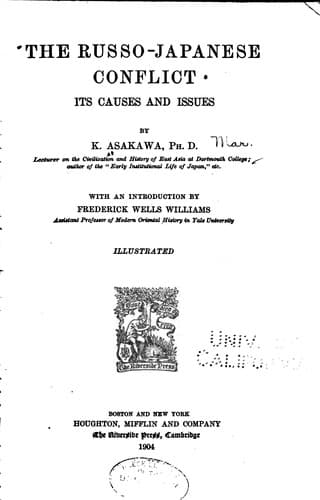
The Russo-Japanese Conflict: Its Causes and IssuesAsakawa, Kan'ichi
History
The Russo-Japanese Conflict: Its Causes and Issues
Asakawa, Kan'ichi
Russo-Japanese War, 1904-1905; Russo-Japanese War, 1904-1905 -- Causes
of the Viceroy’s unconciliatory views, but had otherwise lost the
control of the situation. The reason why Alexieff had risen to such a
great influence may not be known until the relations he had with M.
Bezobrazoff, the late von Plehve, and other influential politicians at
St. Petersburg of that day, become more clearly understood than they are
to-day. As to the probable views of the Viceroy regarding the situation
in the East, it is not hard to infer them from the diplomatic history in
China, Korea, and Japan, during the half year ending with February,
1904.
Let us make a brief review of the diplomatic manœuvres of the Russian
Representative at Peking regarding Manchuria, which proceeded much as if
his Government were not engaged in negotiations with Japan in respect to
the same territory. The secret Manchurian agreement which was reported
to have been concluded on July 20[603] was probably unfounded, and its
detail may otherwise be safely left unnoticed. The nature of the Russian
policy regarding Manchuria could, however, be inferred from the
remarkable exchange of views which took place at London in July between
Lord Lansdowne and the Russian Ambassador, Count Benckendorff. In this
interview on July 11, the latter said, in effect: “Whatever may be the
result of the negotiations which are pending between Russia and
China, ... the Imperial Government [of Russia] has no intention of
opposing the gradual opening of China, as _commercial relations
develop_,[1] of some towns in Manchuria to foreign commerce, _excluding,
however, the right to establish ‘Settlements.’_ This declaration does
not apply to Harbin. The town in question being within the limits of the
concessions for the Eastern Chinese Railway, _is not unrestrictedly
subject to the Chinese Government_;[604] the establishment there of
foreign consulates must therefore depend upon the consent of the Russian
Government.”[605] The three conditions here printed in italics would
seem not only contradictory to the declaration made by Count Lamsdorff
to Mr. MacCormick on April 28,[606] but also almost tantamount to
opposing the opening of any new treaty port in Manchuria. For it was
well understood that the desire on the part of some Powers for the
speedy opening of some new ports in Manchuria was largely calculated to
prevent the aggressive and exclusive proceedings of Russia in that
territory. If, as Count Benckendorff suggested, the development of trade
relations was the sole reason for “gradually” opening some towns, if
foreign settlements should be excluded from the new ports, and if
Harbin, and logically all the towns situated at the “depots” of the
railway, could not be opened without Russian consent, Manchuria,
excepting the regions touching the few towns which had already been
opened, would remain open to the growing influence of Russia, but
practically sealed to the rest of the world.[607] This inference was
presently demonstrated by the new demands made at the Peking Foreign
Public-domain text, read in full here on John Shaqi.
Reviews
Reviews
No reviews yet
Be the first to share your thoughts on this work.
Elsewhere in the archive
Join the Discussion
Join the discussion
Sign in to leave a comment or review.
Sign InorCreate an account