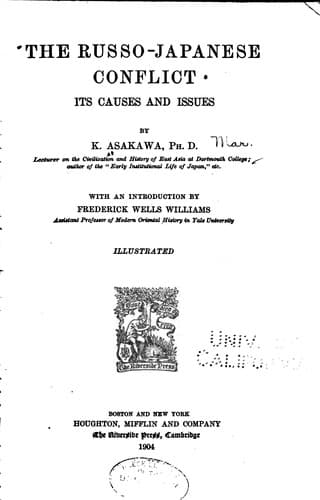
The Russo-Japanese Conflict: Its Causes and IssuesAsakawa, Kan'ichi
History
The Russo-Japanese Conflict: Its Causes and Issues
Asakawa, Kan'ichi
Russo-Japanese War, 1904-1905; Russo-Japanese War, 1904-1905 -- Causes
Office by M. Lessar on September 6. These demands, presented, as they
were, in the midst of the Russo-Japanese negotiations at Tokio and on
the eve of the close of the period of Manchurian evacuation, deserve a
special notice. Briefly stated, M. Lessar requested: (1) that China
should not alienate, in any manner, any port, of whatever size, of
Manchuria to any other Power; (2) that Russia should be allowed to
construct wharves on the Sungari River, to connect them by telegraph,
and to station Russian troops to protect the telegraph lines and the
ships plying the river; (3) that Russia should be allowed to establish
post stations along the road from Tsitishar to Blagovestchensk; (4) that
no greater duties should be imposed on goods brought into Manchuria by
rail than those now imposed on goods transported by road or river; (5)
that after the withdrawal of the Russian troops, the branches of the
Russo-Chinese Bank should be protected by Chinese troops, but at the
cost of the Bank; and (6) that a Russian doctor should be appointed
member of the Sanitary Board at Niu-chwang. On these conditions, the
Russian forces would evacuate Niu-chwang and the rest of the Sheng-king
Province on October 8, the Kirin Province after four months, and the
Hei-lung Province at the end of one year.[608] Of these, the first
demand was interpreted to imply the prevention of the establishment of
new foreign settlements and concessions in any part of Manchuria. As to
the meaning of stationing troops along the Sungari and building a post
road from Tsitsihar to Blagovestchensk, it is instructive to observe
that Prince Ching opined that, if China conceded these demands and
Russia then nominally withdrew, the latter would still be in virtual
possession of the territory.[609] The British and Japanese Ministers at
Peking naturally warned China not to accept the Russian
propositions.[610] The Foreign Office, after some hesitation,[611]
finally refused all of the demands in a written note, on September
24.[612] This refusal, however, by no means terminated the Manchurian
negotiations at Peking. As the Chinese Government showed inclinations,
vacillating as they were, to sympathize with Japan in her efforts to
maintain the sovereign rights of China in Manchuria, M. Lessar is said
to have resorted to occasional threats that, if a war should occur
between Russia and Japan and the latter be defeated, China would repent
her sorry plight only too late, for then Manchuria would not be hers.
Particularly vigorous was his obstruction of the effort of the United
States Commissioners at Shanghai to secure the opening of new ports in
Manchuria to foreign trade.[613] In spite of all this, however, on
October 8—the very day once fixed for the final evacuation of
Manchuria—the American-Chinese treaty was signed, opening Mukden and
An-tung as treaty ports. The next day saw the conclusion of the
Japanese-Chinese treaty, bearing the date of October 8, which also
Public-domain text, read in full here on John Shaqi.
Reviews
Reviews
No reviews yet
Be the first to share your thoughts on this work.
Elsewhere in the archive
Join the Discussion
Join the discussion
Sign in to leave a comment or review.
Sign InorCreate an account