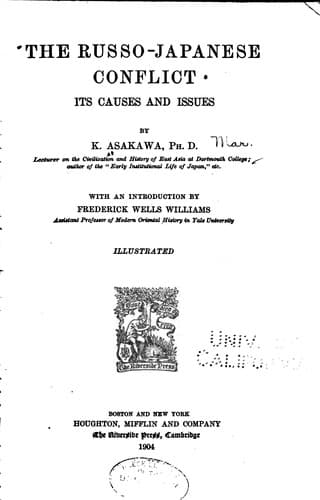
The Russo-Japanese Conflict: Its Causes and IssuesAsakawa, Kan'ichi
History
The Russo-Japanese Conflict: Its Causes and Issues
Asakawa, Kan'ichi
Russo-Japanese War, 1904-1905; Russo-Japanese War, 1904-1905 -- Causes
provided for the opening of Mukden and Tatung-kao. It was perhaps
nothing more than a singular coincidence of circumstances that Mukden
should be, as it was, occupied by Russian soldiers shortly after its
opening had been secured by the United States and Japan. Early in the
morning of October 28, 780 Russian soldiers with eight cannon suddenly,
without warning, rushed through the city gate and took possession of the
_Yamên_ of the Tartar General, Tsêng-chi, holding him in custody and
reducing the military forces under his control.[1] A generally accepted
ground for this precipitous act was naught more than that a subordinate
Taotai under the jurisdiction of the Tartar General had undertaken to
punish some recalcitrant bandits who had been under Russian employ. The
_Journal de Saint Pétersbourg_ explained, however, that the seizure of
Mukden was owing “to the apathy of the Chinese authorities, to the
non-execution of the promises made on their part, and to the agitation
which prevailed in the district.”[614] Mukden being the sepulchral city
of the reigning dynasty of China, its sudden occupation by the Russians
appeared to have aroused a bitter resentment among the educated classes
throughout the Empire.
Turning to the Korean frontier, the conduct of the Russians at
Yong-am-po[615] on the left side of the Yalu, near its mouth, had now
assumed an unmistakably political character. Early in July a telegraphic
connection had been made without permission with An-tung, a strategic
centre in Eastern Manchuria. At the instance of the Japanese Minister,
the Korean Government succeeded in enforcing the removal of the
line.[616] Late in the same month, the Commissioner of Forestry of Korea
and Baron Gunzburg visited Yong-am-po, and drafted an agreement leasing
the port to the Timber Company, nominally represented by the Baron. The
contract bore neither a definite period of time for the lease nor fixed
area of the leased territory, in the Korean text of the agreement, but,
according to the Russian document, the lease is said to have extended
over twenty years and covered a space equivalent to 204 acres. The
company also was granted, in the Korean text, judiciary rights over the
residents within the leased area.[617] At the same time, extensive works
had been started by the Russians at Yong-am-po, including the erection
of large brick buildings and the laying out of roads, streets, and light
railways, to be later increased by what was conceded to be a fort;
while, beyond the river, the military forces at An-tung and other
centres had been in the process of augmentation.[618] The situation had
now become so grave that Mr. Hayashi, Japanese Minister at Seul, was
obliged to enter sharp protests at the Korean Foreign Office against the
conclusion of the lease agreement,[619] and to urge again the opening of
Wiju, and now also of Yong-am-po, to foreign trade. Both the British and
American Representatives also pressed the Seul Government to open these
Public-domain text, read in full here on John Shaqi.
Reviews
Reviews
No reviews yet
Be the first to share your thoughts on this work.
Elsewhere in the archive
Join the Discussion
Join the discussion
Sign in to leave a comment or review.
Sign InorCreate an account