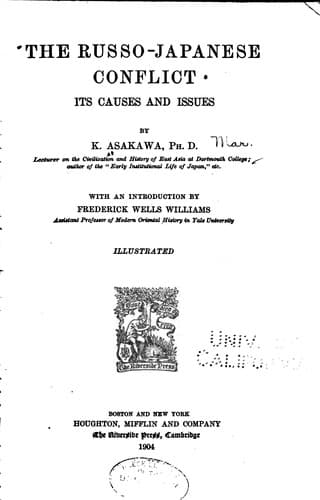
The Russo-Japanese Conflict: Its Causes and IssuesAsakawa, Kan'ichi
History
The Russo-Japanese Conflict: Its Causes and Issues
Asakawa, Kan'ichi
Russo-Japanese War, 1904-1905; Russo-Japanese War, 1904-1905 -- Causes
ports.[620] The Russian Minister, M. Pavloff, however, was as
strenuously opposed to the opening of these ports as Mr. Hayashi was to
the conclusion of the lease agreement. The conditions were almost
identical with those in 1898 under which Great Britain urged the opening
of Talien-wan, so as to counteract the Russian aggression upon it and
Port Arthur, and also with those in Manchuria, in this same year, where
the American and Japanese Governments demanded the opening of new ports
in order to prevent the exclusion of foreign trade and industry from
Manchuria under Russian rule. The struggle between the open and the
exclusive policy, however, continued much longer in Korea than in China,
owing largely to the extremely unstable political conditions at Seul,
which enabled the Russian diplomats oftener and longer to influence the
Korean court.[621] As regards the lease of Yong-am-po, the Korean
Government was now so alive to the serious nature of the agreement that
it proposed to modify its terms late in August.[622] M. Pavloff,
however, persistently urged the Korean Government to ratify the original
agreement. On August 27, for instance, he and Baron Gunzburg remained at
the Foreign Office from one to six o’clock in the afternoon, requesting
the immediate conclusion of the contract, until the Foreign Minister
escaped out of the door and tendered his resignation.[623] At the same
time, the conduct of the Russians on the frontier grew even more
menacing than before. The cutting of timber was started at different
points, where many Koreans were forced into unpaid service, and the
bandits in Russian employ created disorder among peaceful citizens.[624]
Moreover, according to the reports of Korean officials, the Russians had
occupied at Yong-am-po—now named Nicolas—a ground far more extensive
than the lease-area stipulated in the yet unratified agreement.[625] All
this while, the Russians at the Capital exercised a powerful influence
over both Yi Keun-thaik and Yi Yong-ik, two of the most noted
politicians at Seul, and over the strong party upholding the interests
of Lady Öm.[626] It was through these pro-Russian people that the unique
idea of declaring the neutrality of Korea before the outbreak of any
war—an idea which had more than once been unsuccessfully
proposed[627]—was again brought forward, and finally, early in 1904,
carried into effect in an awkward manner.[628]
Public-domain text, read in full here on John Shaqi.
Reviews
Reviews
No reviews yet
Be the first to share your thoughts on this work.
Elsewhere in the archive
Join the Discussion
Join the discussion
Sign in to leave a comment or review.
Sign InorCreate an account