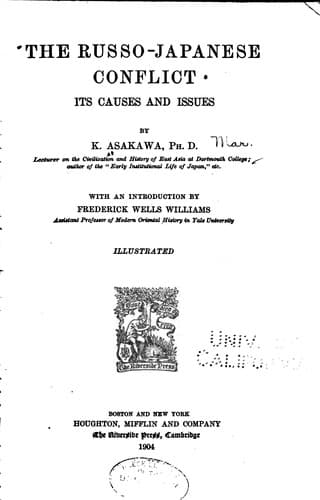
The Russo-Japanese Conflict: Its Causes and IssuesAsakawa, Kan'ichi
History
The Russo-Japanese Conflict: Its Causes and Issues
Asakawa, Kan'ichi
Russo-Japanese War, 1904-1905; Russo-Japanese War, 1904-1905 -- Causes
Russian activity in Korea and Manchuria, which has been briefly
described, may be said to constitute the reverse side of the diplomacy
of the Czar’s Government at Tokio. The actual control of the Eastern
situation having probably passed from the central power to Port Arthur,
it was now founded, perhaps not upon greater practical wisdom than
before, but apparently upon a uniform basis. For the conclusion is
forced upon the student that Viceroy Alexieff’s policy must have been,
on the one hand, to deal with Japan’s overtures lightly and leisurely,
but, on the other, to hasten the establishment of Russian control in
Manchuria and upon the Korean frontier, so that Japan might in time be
compelled to bow to the situation and accept terms dictated by Russia.
The proof of this policy had already seemed abundantly sufficient by the
time when the Russian counter-note reached Baron Komura on October 3. It
is impossible to tell whether, in framing such a policy, the Viceroy had
taken into consideration the fact that the entire nation of Japan felt
as one man that they had come to the greatest crisis known in their long
history.
-----
Footnote 580:
Viscount Katsura, Premier; Baron Komura, Foreign Minister; and Messrs.
Terauchi and Yamamoto, Ministers, respectively, of the Army and Navy.
Footnote 581:
Marquises Itō and Yamagata, and Counts Matsukata, Inoüé and Ōyama.
Footnote 582:
The Japanese dailies.
Footnote 583:
The _Nichi-Ro Kōshō ni kwan su ru Ōfuku_ (diplomatic correspondence
respecting the negotiations between Japan and Russia), dispatch No. 1.
This correspondence (hereafter abbreviated as _N.-R._) was presented
by the Japanese Government to the Houses of the Imperial Diet,
respectively, on March 23 and 26, and published in the _Kwampō_
(Official Gazette) of March 24 and 27, 1904. It contains fifty-one
dispatches, all telegraphic, covering the period of more than six
months between the opening of the negotiations and the severance of
all diplomatic relations between the two Powers, namely, between July
28, 1903, and February 6, 1904.
An authoritative English translation of this correspondence has been
issued from Washington, probably by members of the Japanese Legation
there. In the quotations from the correspondence that appear in these
pages, the language of the translation—accurate as it is—has been
largely changed, in order to make it coincide as closely as possible
with the literal meaning of the original.
Footnote 584:
_N.-R._, No. 2.
Footnote 585:
It is singular that even Count Lamsdorff should thus participate in
the characteristic plaint of the Russians that they are an object of
unjust machinations of other nations.
Footnote 586:
_N.-R._, No. 3, received at Tokio on August 6.
Footnote 587:
Public-domain text, read in full here on John Shaqi.
Reviews
Reviews
No reviews yet
Be the first to share your thoughts on this work.
Elsewhere in the archive
Join the Discussion
Join the discussion
Sign in to leave a comment or review.
Sign InorCreate an account