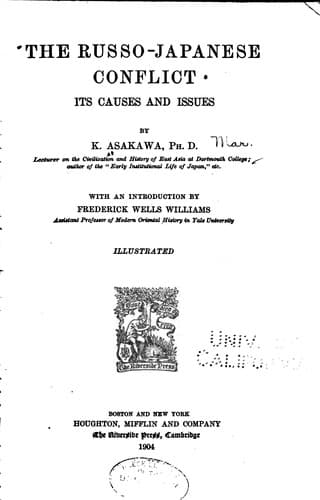
The Russo-Japanese Conflict: Its Causes and IssuesAsakawa, Kan'ichi
History
The Russo-Japanese Conflict: Its Causes and Issues
Asakawa, Kan'ichi
Russo-Japanese War, 1904-1905; Russo-Japanese War, 1904-1905 -- Causes
These men were, according to Article 2 of the Statutes of September
30, “the Ministers of the Interior, of Finance, of Foreign Affairs,
and of War, the head of the Ministry of Marine, and such persons as
His Majesty the Emperor may find it expedient to summon, either to sit
permanently on the committee, or to take part temporarily at its
meetings. The Viceroy of the Far East, being, by his duties, a member
of the committee, shall be present at the meetings when he is in St.
Petersburg.”
Footnote 588:
The _British Parliamentary Papers: China, No. 2 (1904)_, No. 144.
Footnote 589:
_Ibid._, No. 155.
Footnote 590:
After the opening of hostilities in February of the present year, the
Russian Foreign Office made a statement of Russia’s case, in which it
was said that, when the Japanese Government proposed in August, 1903,
to open the negotiations, “Russia consented, and Viceroy Alexieff was
charged to draw up a project for a new understanding with Japan in
coöperation with the Russian Minister at Tokio....” See p. 327, note
9, below.
Footnote 591:
_N.-R._, No. 6.
Footnote 592:
Evidently the reference is to the three Russo-Japanese agreements
concerning Korea concluded in 1896 and 1898.
Footnote 593:
_N.-R._, No. 3, originally dated Tokio, August 6.
Footnote 594:
_N.-R._, No. 7.
Footnote 595:
The _British Parliamentary Papers: China, No. 1 (1898)_, Nos. 100 and
109.
Footnote 596:
_N.-R._, Nos. 8, 11.
Footnote 597:
_N.-R._, Nos. 10, 11.
Footnote 598:
_Ibid._, No. 14, September 7.
Footnote 599:
_N.-R._, No. 17.
Footnote 600:
The Russian Government explained later, in the note delivered on
January 6, 1904, that the creation of a neutral zone was “for the very
purpose which the Imperial Japanese Government had likewise in view,
namely, ‘to eliminate everything that might lead to misunderstandings
in the future;’ a similar zone, for example, existed between the
Russian and British possessions in Central Asia.”—_N.-R._, No. 38.
It is easy to see, however, that _neutralization_ is merely _common
appropriation_ in a negative form, and might, like cases of the
latter, as in Primorsk and Sakhalien, result in _absorption_ by one of
the two Powers between which the territory was neutralized.
Footnote 601:
_N.-R._, No. 20.
Footnote 602:
Before August 13, when he was appointed Viceroy of the Far East,
Alexieff was as yet Governor-General of the Kwan-tung region.
Footnote 603:
The Japanese dailies.
Footnote 604:
The italics in the quotation are the author’s.
Footnote 605:
_China, No. 2 (1904)_, No. 133 (Lansdowne to Scott).
Footnote 606:
See pp. 246–248, above.
Footnote 607:
Public-domain text, read in full here on John Shaqi.
Reviews
Reviews
No reviews yet
Be the first to share your thoughts on this work.
Elsewhere in the archive
Join the Discussion
Join the discussion
Sign in to leave a comment or review.
Sign InorCreate an account