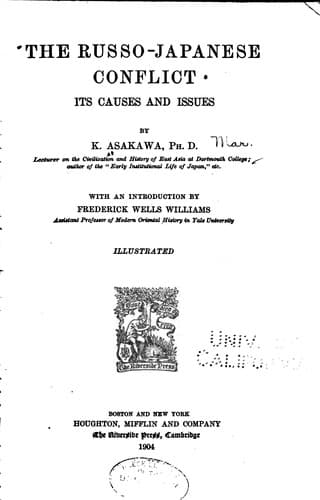
The Russo-Japanese Conflict: Its Causes and IssuesAsakawa, Kan'ichi
History
The Russo-Japanese Conflict: Its Causes and Issues
Asakawa, Kan'ichi
Russo-Japanese War, 1904-1905; Russo-Japanese War, 1904-1905 -- Causes
“‘The Imperial Government, in their original proposition to the
Russian Government in August last, endeavored to make it entirely
clear that they desired, with a view to remove from the
Japanese-Russian relations every cause for future misunderstanding,
to bring within the purview of the proposed arrangement all those
regions in the Extreme East where the interests of the two Empires
met. They cannot believe that a full realization of that desire
could be expected if a large and important section of those regions
was wholly excluded from the understanding. Accordingly, the
Imperial Government feel constrained to ask the Russian Government
to reconsider their position on the subject, and they hope that the
Russian Government will be able to see their way to arrive at a
satisfactory solution of the question.
[Illustration:
MR. KURINO
_Late Japanese Minister at St. Petersburg_
]
“‘The Imperial Government also find it necessary to ask for the
following amendments to the new Russian counter-proposals:—
“‘_a._ ARTICLE II. to read: Recognition by Russia of Japan’s
preponderating interests in Korea, and of the right of Japan to give
Korea advice and assistance tending to improve the administration of
the Korean Empire;
“‘_b._ ARTICLE V. to read: Mutual engagement not to undertake on the
Korean coast any military works capable of menacing the freedom of
navigation in the Korean Straits; and
“‘_c._ ARTICLE VI. to be suppressed.
“‘Not only as the main points of these amendments cannot be said to
be in excess of the modifications which were agreed to _ad
referendum_ at Tokio, but also as the Imperial Government considered
those changes indispensable, it is believed that they will receive
the ready agreement of the Russian Government.’
“In presenting the foregoing note to Count Lamsdorff, you will say
that I have spoken to Minister Rosen in a similar sense, and you
will also express the desire for a prompt reply.”[645]
Mr. Kurino carried out his instructions on December 23, and telegraphed
on the same day to Baron Komura: “... He [Count Lamsdorff] told me he
had received a telegram from Minister Rosen, stating that the latter had
had an interview with Baron Komura, and that particulars would follow;
but such particulars had not yet been received by him [the Count.][646]
When I handed him the _note verbale_, he received it, and said that he
would do his best to send the Russian answer at the earliest possible
date; but added that he would have to communicate with Viceroy Alexieff.
In conclusion I stated to the Count that, under existing circumstances,
it might cause serious difficulties, even complications, if we failed to
come to an _entente_, and I hoped he would exercise his best influence
so as to enable us to reach the desired end.”[647]
Public-domain text, read in full here on John Shaqi.
Reviews
Reviews
No reviews yet
Be the first to share your thoughts on this work.
Elsewhere in the archive
Join the Discussion
Join the discussion
Sign in to leave a comment or review.
Sign InorCreate an account