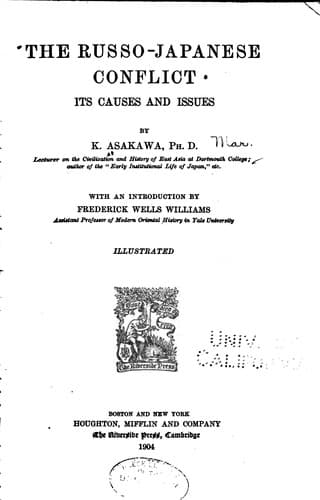
The Russo-Japanese Conflict: Its Causes and IssuesAsakawa, Kan'ichi
History
The Russo-Japanese Conflict: Its Causes and Issues
Asakawa, Kan'ichi
Russo-Japanese War, 1904-1905; Russo-Japanese War, 1904-1905 -- Causes
“Japan’s contention in defense of the attack on the Russian ships at
Chemulpo, that the port was not neutral on February 9, is false,
again because Korea had proclaimed her neutrality.
“Japan’s denial of malicious interference with the transmission of
Russian telegrams over the Danish cable cannot be sustained. A
telegram to Baron Rosen (then Russian Minister to Japan), at Tokio,
sent from St. Petersburg February 4, was not delivered till the
morning of February 7. That delay did not occur on the Siberian
line, as was shown by the fact that a reply to a telegram from
Viceroy Alexieff sent at the same time was received the same day.
Therefore, it is conclusive that the Rosen telegram was held by the
Japanese and not delivered for two days.
“Communication with M. Pavloff (then Russian Minister to Korea) by
the Korean telegraph ceased in the middle of January. As the Koreans
were enjoying friendly relations with Russia, there is good ground
for believing that the interruption was due to the Japanese.
Thereafter M. Pavloff used a mail steamer or a special warship to
communicate with Port Arthur. The Minister of Russia at Seul
February 8, therefore, knew nothing of the diplomatic rupture.
“Japan pleads that the charge against her seizure of Russian
merchantmen before the declaration of war cannot lie after the
establishment of prize courts. Their seizure before the declaration
of war being piracy is not defensible by the establishment of prize
courts, which cannot exist before a declaration of war. The steamer
‘Russia’ was seized in the waters of Southern Korea even before M.
Kurino had presented his note here.
“The reply concludes: ‘Our information regarding Japan’s
announcement that in future Korea would be under her administration
came from M. Pavloff and also from the Representative of a friendly
Power at Seul. Japan’s denial, consequently, is fruitless, as also
is the attempt to refute our statement that the Russian Minister and
Consul at Seul were told to leave. We had conclusive proof in St.
Petersburg on February 10 that the French Minister at Seul had
officially notified our Representatives that the Japanese Government
had intimated that they should leave, and that the Japanese had
occupied territory in Korea. M. Pavloff was unable to notify our
Consul at Fusan, his telegram being refused at the telegraph
office.’”
-----
Footnote 629:
_N.-R._, Nos. 18, 19, 20, 21.
Footnote 630:
The Japanese dailies.
Footnote 631:
_N.-R._, No. 22.
Footnote 632:
In Article 3 of the Nishi-Rosen Protocol of 1898, and in Article 2 of
the Russian counter-note of October 3.
Footnote 633:
See the same Article of the counter-note.
Footnote 634:
Article 8.
Footnote 635:
Article 2.
Footnote 636:
Articles 4 and 8.
Footnote 637:
Article 7.
Footnote 638:
Article 9.
Footnote 639:
Article 3, made necessary from the past experience in Korea.
Public-domain text, read in full here on John Shaqi.
Reviews
Reviews
No reviews yet
Be the first to share your thoughts on this work.
Elsewhere in the archive
Join the Discussion
Join the discussion
Sign in to leave a comment or review.
Sign InorCreate an account