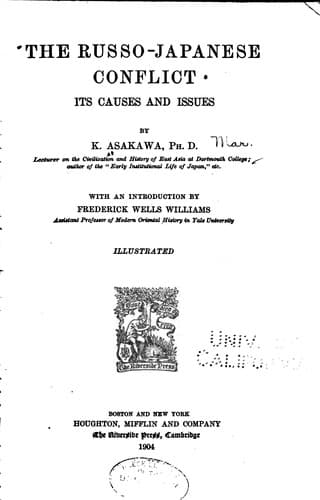
The Russo-Japanese Conflict: Its Causes and IssuesAsakawa, Kan'ichi
History
The Russo-Japanese Conflict: Its Causes and Issues
Asakawa, Kan'ichi
Russo-Japanese War, 1904-1905; Russo-Japanese War, 1904-1905 -- Causes
Footnote 640:
Article 5.
Footnote 641:
Article 6.
Footnote 642:
Observe the following passage from the explanatory note issued by the
Foreign Office at St. Petersburg on February 9, 1904:—
“Last year, the Tokio Cabinet, under the pretext of establishing the
balance of power and a more settled order of things on the shores of
the Pacific, submitted to the Imperial Government a proposal for a
revision of the existing treaties _with Korea_. Russia consented, and
Viceroy Alexieff was charged to draw up a project for a new
understanding with Japan in coöperation with the Russian Minister at
Tokio, who was intrusted with the negotiations with the Japanese
Government. Although the exchange of views with the Tokio Cabinet on
this subject was of a friendly character, Japanese social circles and
the local and foreign press attempted in every way to produce a
warlike ferment among the Japanese, and to drive the Government into
an armed conflict with Russia. Under the influence thereof, the _Tokio
Cabinet began to formulate greater and greater demands in the
negotiations_, at the same time taking most extensive measures to make
the country ready for war.” (The italics are the author’s.)
Footnote 643:
_N.-R._, Nos. 26, 27, 28, 29, 30, 32, 33.
Footnote 644:
The second reply was as follows:—
“1. Mutual engagement to respect the independence and territorial
integrity of the Korean Empire.
“2. Recognition by Russia of Japan’s preponderating interest in Korea,
and of the right of Japan to assist Korea with advice tending to
improve her civil administration.
“3. Engagement on the part of Russia not to oppose the development of
the industrial and commercial activities of Japan in Korea, nor the
adoption of measures for the protection of those interests.
“4. Recognition by Russia of the right of Japan to send troops to
Korea for the purpose mentioned in the preceding Article, or for the
purpose of suppressing insurrections or disorders liable to create
international complications.
“5. Mutual engagement not to make use of any part of the Korean
territory for strategical purposes, and not to undertake on the Korean
coast any military works capable of menacing the freedom of navigation
in the Korean Straits.
“6. Mutual engagement to consider the territory of Korea to the north
of the thirty-ninth parallel as a neutral zone, within the limits of
which neither of the contracting parties shall introduce troops.
“7. Mutual engagement not to impede the connection of the Korean and
Eastern Chinese Railways, when those railways shall have been extended
to the Yalu.
“8. Abrogation of all previous agreements between Russia and Japan
respecting Korea.”—_N.-R._, No. 34.
Footnote 645:
_N.-R._, No. 35.
Footnote 646:
Is it probable that Baron Rosen consulted Viceroy Alexieff by
telegraph before he did Count Lamsdorff?
Footnote 647:
_N.-R._, No. 36.
Public-domain text, read in full here on John Shaqi.
Reviews
Reviews
No reviews yet
Be the first to share your thoughts on this work.
Elsewhere in the archive
Join the Discussion
Join the discussion
Sign in to leave a comment or review.
Sign InorCreate an account