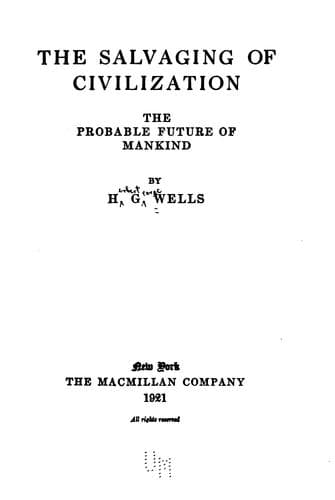
The Salvaging of CivilizationWells, H. G. (Herbert George)
Philosophy
The Salvaging of Civilization
Wells, H. G. (Herbert George)
Civilization, Modern -- 20th century; Education
I do not think that our educational and university authorities realize
how far the college stage of education has already escaped from the
local limitations of colleges; they do not understand what a great and
growing volume of adolescent learning and thought, of college education
in the highest and best sense of the word, goes on outside the walls of
colleges altogether; and on the other they do not grasp the significant
fact that, thanks to the high organization of sports and amusements and
social life in our more prosperous universities, a great proportion of
the youngsters who come in to their colleges never get the realities of
a college education at all, and go out into the world again as shallow
and uneducated as they came in. And this failure to grasp the great
change in educational conditions brought about, for the most part, in
the last half-century, accounts for the fact that when we think of any
extension of higher education in the modern community we are all too apt
to think of it as a great proliferation of expensive, pretentious
college buildings and a great multiplication of little teaching
professorships, and a further segregation of so many hundreds or
thousands of our adolescents from the general community, when as a
matter of fact the reality of education has ceased to lie in that
direction at all. The modern task is not to multiply teachers _but to
exalt and intensify exceptionally good teachers_, to recognize their
close relationship with the work of university research--which it is
their business to digest and interpret--and to secure the production and
wide distribution of books throughout the community.
I am inclined to think that the type of adolescent education, very much
segregated in out-of-the-way colleges and aristocratic in spirit, such
as goes on now at Oxford, Cambridge, Yale, Holloway, Wellesley and the
like, has probably reached and passed its maximum development. I doubt
if the modern community can afford to continue it; it certainly cannot
afford to extend it very widely.
But as I have pointed out, there has always been a second strand to
college education--the technical side, the professional training or
apprenticeship. Here there are sound reasons that the student should go
to a particular place, to the special museums and laboratories, to the
institutes of research, to the hospitals, factories, works, ports,
industrial centres and the like where the realities he studies are to be
found, or to the studios or workshops or theatres where they practise
the art to which he aspires. Here it seems we have natural centres of
aggregation in relation to which the college stage of a civilized
community, the general adolescent education, the vision of the world as
a whole and the realization of the individual place in it, can be
organized most conveniently.
Public-domain text, read in full here on John Shaqi.
Reviews
Reviews
No reviews yet
Be the first to share your thoughts on this work.
Elsewhere in the archive
Join the Discussion
Join the discussion
Sign in to leave a comment or review.
Sign InorCreate an account