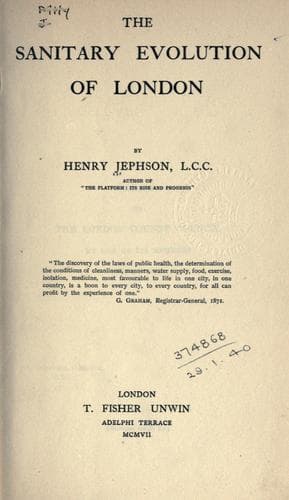
The Sanitary Evolution of LondonJephson, Henry (Henry Lorenzo)
History
The Sanitary Evolution of London
Jephson, Henry (Henry Lorenzo)
Public health -- England -- London
"Whereas ... the sewage of towns situate on the river Thames above
the metropolis is carried into the river, and thereby its waters are
polluted and the health and comfort of the inhabitants of the valley
of the river below those towns of the metropolis are affected," powers
were given for the diversion therefrom of the sewage of Oxford,
Reading, Kingston, Richmond, &c., &c., "whose cloacal contributions to
the stream were distributed to masses of the people of London." No
less than 56 towns, it was said, cast their impurities into the river.
And in the following year the scope of the Thames Conservancy Board
was extended and very stringent care exercised to prevent unnecessary
pollution of the river. And in 1868 the river Lea, another of the water
suppliers, was placed under a Conservancy Board.
In 1867 an Act of far-reaching consequence was passed, making
vaccination compulsory. In 1836 an Act[109] dealing with this matter
laid it down that the parent of a child, or the occupier of the house
in which a child was born, might, within 40 days, give notice to the
Registrar as to the vaccination of the child. There was no punishment
for the neglect to do so, and no penalty for refusal to give the
Registrar the information.
This new Act, which came into operation on the 1st of January, 1868,
enacted that--
"Every child shall be vaccinated within three months of its birth."
The Act was to be administered by the Poor Law Authorities; and Boards
of Guardians might appoint public vaccinators and establish vaccination
stations.
In 1867, also, another Act of very great consequence was passed dealing
with one important element in the sanitary evolution of London,
to which no reference has yet been made, namely, the provision of
hospitals for the isolation of infectious or contagious disease, for
the prevention of mortality, and for the speedy restoration of the sick
to health.
There is, indeed, no part of sanitary work requiring more constant
attention than the protection of the community from the spread of
infectious diseases, and this is best secured by hospitals affording
proper provision for isolation and treatment of infectious cases.
Next to the adoption of proper measures for the prevention of disease,
a suitable provision for the speedy restoration of the sick to health
is obviously of the greatest importance to the community.
So far as the absolutely destitute were concerned, all had, by the law
of England, subject to certain conditions, right to food, shelter, and
medical attendance; and they accordingly received gratuitous medical
treatment at workhouses, or dispensaries, and in sick wards.
Public-domain text, read in full here on John Shaqi.
Reviews
Reviews
No reviews yet
Be the first to share your thoughts on this work.
Elsewhere in the archive
Join the Discussion
Join the discussion
Sign in to leave a comment or review.
Sign InorCreate an account