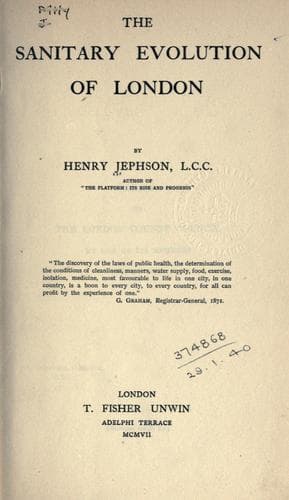
The Sanitary Evolution of LondonJephson, Henry (Henry Lorenzo)
History
The Sanitary Evolution of London
Jephson, Henry (Henry Lorenzo)
Public health -- England -- London
And so all these evil practices were very widely indulged in; for
though there were many respectable men among builders of small houses,
there were many who, regardless of all consequences, covered the
suburbs with "small, rotten houses." And immense numbers of the people
were absolutely unprotected either by the Government or by the local
authority from abuses which entailed upon them ill-health and death,
and from practices which created and spread disease throughout the
community.
The Medical Officer of Health for St. George-the-Martyr, Southwark,
referring to "the dishonest and scandalous way" in which some houses
were built, said (1877-8):--
"From the greed of a few builders this traffic in human life, and in
what makes life valuable, is openly and defiantly carried on. Under
such circumstances full health is impossible. Yet for the success
and permanence of natural existence a high standard is absolutely
necessary."
Of builders such as these it may be truly said that having created a
_damnosa hereditas_ in one place, they moved on to create fresh ones in
others, and no one prevented them.
So glaring were these evils that a Select Committee, which sat in
1874 on the Metropolitan Buildings and Management Bill of that year,
recommended--
"That the District Surveyor or the Metropolitan Board shall have full
power to stop the progress of any building in which the materials or
construction is calculated to be dangerous or injurious to health, and
to summon the builder or owner before the magistrate."
At the rate houses were being built, the defective Building Laws were a
grave disaster.
In the two parishes of Bow and Bromley in Poplar, in the five years
ending March, 1878, notices were approved for 1,981 new buildings.
In Hackney, in the year 1876-7, notices were given of intention to
erect 800 new houses, and the extension of streets and houses into the
fields had gone on so rapidly that by that time there were but few
fields left in the district, or even large grounds belonging to any of
the houses.
In Kensington it was reported in 1875 that the increase in the number
of new houses brought into occupation had for a considerable period
averaged 700 annually.
In Wandsworth, in 1874-5, notices were received for 887 new houses.
In 1877-8 for 1,432 new houses.
" 1878-9 " 1,845 "
" 1880-1 " 3,073 "
And in every place land was being grabbed for building purposes.
The Medical Officer of Health for Whitechapel wrote in 1879:--
Public-domain text, read in full here on John Shaqi.
Reviews
Reviews
No reviews yet
Be the first to share your thoughts on this work.
Elsewhere in the archive
Join the Discussion
Join the discussion
Sign in to leave a comment or review.
Sign InorCreate an account