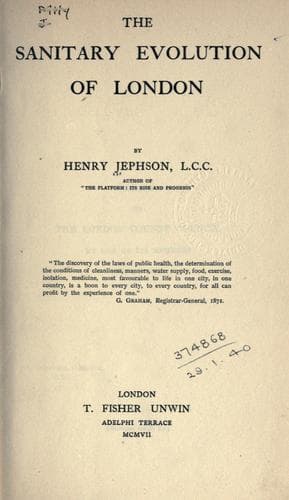
The Sanitary Evolution of LondonJephson, Henry (Henry Lorenzo)
History
The Sanitary Evolution of London
Jephson, Henry (Henry Lorenzo)
Public health -- England -- London
"We are now paying very dearly both in health and money for the errors
of preceding generations in their having allowed houses to be packed
closely together.... Several cases have recently occurred in this
district of landlords erecting dwelling-houses in the back-yards of
those houses which were formerly occupied by a single family. This is
a serious evil and ought to be prevented. We have power to prevent the
overcrowding of rooms, and we certainly ought to have power to prevent
the cramming together of houses on sites of insufficient size for the
healthy existence of the tenants."
Even burial-grounds were not sacred, nor were public authorities even
immaculate in this respect. Thus in St. Luke:--
"The Quakers' burial-ground by the side of Coleman Street is now
(1876) in progress towards being covered with buildings, and a portion
was taken by the London School Board for the erection of a school.
In the process of excavation for the foundation, human remains were
discovered."
And the areas at the backs of houses were also being rapidly covered
over. The Act of 1855 had provided that 100 superficial feet should be
left open--
"But the exigencies of trade have led the Metropolitan Board of Works
and the District Surveyors to permit the area on the ground storey to
be covered over."[119]
In fact, the insufficiency of the laws as regarded buildings intended
for human habitation, and the mal-administration or non-administration
of those laws which existed, resulted in the creation of evils which
inevitably and most injuriously affected the health of the public, not
merely at the time, but for many years to come.
The Medical Officer of Health for St. Giles', in 1871, pointed out the
necessity of a change of the law.
"It is very much to be desired that the law gave more stringent powers
to local authorities to prevent the re-erection of buildings upon the
old sites, so that the new buildings might not become as unfavourable
to health as the old ones.... Such a perpetuation of mischief ought not
to be permitted, and the rights of landlords should be subordinated to
the public good."
The condition of existing, as apart from new, houses also stood in need
of many changes of the law to effect their redemption. The necessity
was forcibly portrayed by the Medical Officer of Health for St.
Marylebone in 1870. He wrote:--
"Of all the obstacles that stand in the way of anything like effective
sanitary operations, not only in St. Marylebone, but in nearly every
other district of the metropolis, there are none so formidable, so
apparently irremediable as the miserable house accommodation provided
for the labouring classes. Year after year I am called upon to tell
the same unvarying story of rotten floors, broken walls and ceilings,
windows and roofs that let in the wind and the rain, chimneys that will
not let out the smoke, and of these wretched tenements being crowded
with honest, hard-working people, from the cellars to the attics."
Public-domain text, read in full here on John Shaqi.
Reviews
Reviews
No reviews yet
Be the first to share your thoughts on this work.
Elsewhere in the archive
Join the Discussion
Join the discussion
Sign in to leave a comment or review.
Sign InorCreate an account