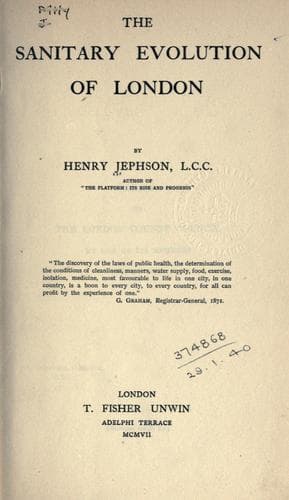
The Sanitary Evolution of LondonJephson, Henry (Henry Lorenzo)
History
The Sanitary Evolution of London
Jephson, Henry (Henry Lorenzo)
Public health -- England -- London
Parliament continued in this decade the greater solicitude about
and interest in matters connected with the public health, which it
had recently been showing; and the first year of the decade, 1871,
is noteworthy for the adoption by Parliament of a measure which had
far-reaching effects upon the sanitary evolution of the metropolis.
This was the creation (by "The Local Government Board Act, 1871") of a
Central Government Authority for the supervision by Government of the
sanitary authorities in England and Wales, and also of those in London.
Matters relating to the health of the people had become so large a
portion of the work of government, that the necessity had forced itself
upon Parliament of concentrating in one department of the Government
the supervision of the laws relating to the public health, the relief
of the poor, and local government.
The new authority, which was entitled the Local Government Board, was
not a representative body, but was a Government Department. It was to
consist of a President, appointed by the Queen, and of the following
"ex-officio" members--the Lord President of the Privy Council, all the
Secretaries of State for the time being, the Lord Privy Seal, and the
Chancellor of the Exchequer.
All the powers of the Poor Law Board were transferred to it, also
certain powers and duties vested in Her Majesty's Privy Council.
Several of the powers vested in or imposed on a Secretary of State,
relative to health matters, were also transferred to it. Henceforth
no bye-laws made by the sanitary authorities in connection with their
duties were to be of any force until approved by the new Board.
Also the Board was to possess, in reserve for great epidemic
emergencies, a power to issue directions under the Diseases Prevention
Act, 1855.
But with the exception of such special cases, the function of the new
Central Authority in regard of local sanitary action was primarily one
of observation and inquiry.
The various Vestries and District Boards of the Metropolis being
sanitary authorities thus came under the supervision, and in some
respects under the control, of the new Central Government Board,
instead of, as previously, under a branch of the office of the
Secretary of State for the Home Department; but to all intents and
purposes they retained their liberty of administration, or, to state it
more accurately, their liberty of non-administration. Their relations
to the elected central body, the Metropolitan Board of Works, remained
unchanged.
In 1871, also, Parliament dealt with the water supply of London. The
essential importance to the health of the population, especially in
large towns, of an adequate supply of wholesome water was becoming more
generally recognised.
Public-domain text, read in full here on John Shaqi.
Reviews
Reviews
No reviews yet
Be the first to share your thoughts on this work.
Elsewhere in the archive
Join the Discussion
Join the discussion
Sign in to leave a comment or review.
Sign InorCreate an account