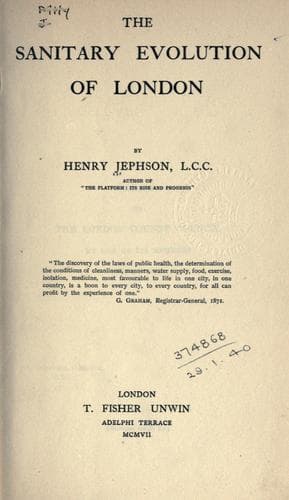
The Sanitary Evolution of LondonJephson, Henry (Henry Lorenzo)
History
The Sanitary Evolution of London
Jephson, Henry (Henry Lorenzo)
Public health -- England -- London
"Without water life cannot be sustained, cleanliness cannot be
maintained, sanitary measures are at a standstill, drains become
blocked, offensive and deleterious gases are retained or driven back
into the dwellings, disease is caused and fostered, and public as well
as private injury caused in all directions."
The Act of 1852 had failed to secure for the inhabitants the advantage
which they ought to have long since enjoyed, of a well-regulated supply
of water in their houses for domestic purposes.
A Select Committee of the House of Commons recommended that every
company should afford a constant supply of water to each house,[120] so
that the water might be drawn direct and fresh from the company's pipes
at all times during the twenty-four hours, and free from the pollution
so often acquired in dirty receptacles. And a Royal Commission,
appointed in 1867, after an elaborate inquiry,[121] declared that
earnest and prompt efforts ought to be made to introduce the constant
service system to the furthest extent possible in the metropolis.
The Report of the Royal Commission is memorable for the very strong
expression of opinion that the water supply of the metropolis should be
consolidated under public control.
The duty of supplying the inhabitants of a city with water had from a
very early period been regarded as a peculiarly municipal function, and
the supersession of the municipalities by joint stock companies was a
comparatively modern innovation.
Thus far, however, Parliament was not disposed to go. But (by the
Metropolis Water Act, 1871) Parliament--contenting itself mostly with
"mights"--directed that any company might propose to give a constant
supply of water, or the Metropolitan Board of Works might apply to a
company for it; failing both of which, and under certain conditions,
the Board of Trade might require a constant supply to be provided. Also
every company should--
"On Sundays, as on other days, supply sufficient pure and wholesome
water for the domestic use of the inhabitants within their limits."
But the Act did not curtail the power of the companies to cut off the
supply to a house if the water-rate was not paid by the landlord or
owner. An opinion was expressed on this point by the Medical Officer of
Health for St. Mary, Newington, in 1872:--
"I maintain that water is absolutely necessary for the health,
cleanliness, and sanitary condition of every one, and that if a
monopoly of its supply is granted to any company, no power of
withholding it should be allowed.
"In the present and increasing crowded condition of our poorer houses
the act of one person may enable a water company to refuse it to a
household of ten or twelve people.... I do most strongly protest
against a continuation of a power which in its exercise undermines the
very foundation of sanitary improvement."
Public-domain text, read in full here on John Shaqi.
Reviews
Reviews
No reviews yet
Be the first to share your thoughts on this work.
Elsewhere in the archive
Join the Discussion
Join the discussion
Sign in to leave a comment or review.
Sign InorCreate an account