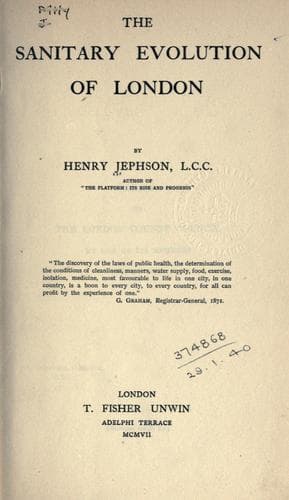
The Sanitary Evolution of LondonJephson, Henry (Henry Lorenzo)
History
The Sanitary Evolution of London
Jephson, Henry (Henry Lorenzo)
Public health -- England -- London
The striking fact about the inspections made is the very high
proportion of houses in which the sanitation was defective.
In Bermondsey, in 1879, where 1,577 houses and premises were inspected,
1,495 notices were served.
In Limehouse, in 1879, 1,411 houses were inspected; and 1,070 orders
for sanitary amendments issued.
In Shoreditch, where there were 15,500 houses, the two Sanitary
Inspectors appear to have done a lot of useful sanitary work. In
1877-8, 5,465 separate nuisances dangerous to health were abated.
If anything like a similar proportion prevailed generally throughout
London, the housing of its huge population was indeed in a dreadful
state.
In some ways the local authorities were awakening to their
responsibilities, and beginning to avail themselves of some of the
provisions placed by Parliament at their disposal.
In Paddington, St. Giles', and Rotherhithe, the Vestries had adopted
the Baths and Washhouses Act of 1846, and thus helped to promote habits
of cleanliness, and to diminish some of the insanitary evils consequent
on the tenements being turned into temporary wash-rooms.
And in St. James' (Westminster) and Lambeth, mortuaries had been
provided, which, in some cases, at any rate, obviated some of the
insanitary evils consequent on the retention of dead bodies for long
periods in single-roomed tenements where death had been caused by
contagious or infectious diseases.
More action was being taken, too, as regards the disinfection of rooms
where there had been cases of infectious disease. Thus in Lambeth in
1877-8, 824 houses were disinfected.
Here and there, too, the owners of noxious trades were being compelled
to adopt methods rendering their businesses less insanitary and
objectionable to their neighbourhoods.
The Local Government Board had caused an elaborate inquiry to be made
by Dr. Ballard as to--
"'In what measure and by what means nuisances and injury to health from
offensive businesses might be avoided,' and the report led to quite a
satisfactory result.
"It showed that by the application of such knowledge as was at
command, all or nearly all businesses that are in a serious degree
offensive might be carried on either without offence, or with such
important reduction of offence, as should make it tolerable, or even
trivial."[131]
In Fulham several piggeries were closed by law; not without regret,
apparently, for the Medical Officer of Health stated in his report:--
"It certainly is very hard on the pig keepers individually, but it
is in accordance with the recognised law of civilisation, that the
interests of the few must be sacrificed to the welfare of the many."
Upon one course of action all the Medical Officers of Health were in
agreement--the absolute necessity of inspection and supervision of the
houses of the people. In season and out of season they advised it, and
urged it as the most essential and the most useful of all duties.
Public-domain text, read in full here on John Shaqi.
Reviews
Reviews
No reviews yet
Be the first to share your thoughts on this work.
Elsewhere in the archive
Join the Discussion
Join the discussion
Sign in to leave a comment or review.
Sign InorCreate an account