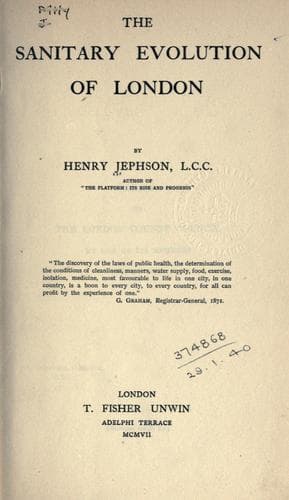
The Sanitary Evolution of LondonJephson, Henry (Henry Lorenzo)
History
The Sanitary Evolution of London
Jephson, Henry (Henry Lorenzo)
Public health -- England -- London
In support of these views they could point to the results of inspection
and supervision in the registered Common Lodging Houses.
In the parish of Spitalfields (in Whitechapel, 1880) there were 109
of these houses containing 454 rooms registered to accommodate 3,992
lodgers. The class of persons occupying them were, notoriously, the
very lowest.
"We failed to learn that any respectable mechanic with his wife and
family ever applied at these houses for lodging accommodation. Yet,"
reported the Sanitary Inspector (1880), "we discovered no case of
overcrowding. The bedding was clean; the yards and closets were in a
good sanitary condition; there was a good water supply, and the walls
and ceilings of the houses were clean."
If these results were obtainable in dealing with the worst classes,
in the overcrowded parts of Whitechapel, _a fortiori_, inspection and
supervision would have been productive of similar benefits among the
general tenement population.
The Medical Officer of Health for St. George-in-the-East referred
to the low mortality in model lodging-houses, where also there was
supervision.
"There we find good sound dwellings, &c., &c. No overcrowding is
permitted, only a certain number in family being accepted as tenants.
Cleanliness on their part is expected--enforced if necessary--or a
notice to quit is speedily given."
While thus recommending inspection, supervision, and compulsory rules,
another view was also expressed.[132]
"As laws have been enacted for the abatement of overcrowding, it is
easy to say: 'let those in authority put them in force'; but I much
fear unless the question is taken up with a spirit of love towards the
poorer and more ignorant classes by the upper and middle classes, and
measures adopted to give instruction to the poor in matters concerning
their physical well-being, the existing state of things will long
continue."
"No class will become civilised by being left to themselves, as
unfortunately is the case in the numerous back slums of London, but
improvement, physically and socially, can only be effected by a
superior class mixing and associating with a class below them."
The Medical Officer of Health for Poplar wrote:--
"The poor want more than model dwellings, more than warmth, food and
clothing; they want humanity, and the knowledge of the laws governing
health."
Unfortunately those remedies were, at best, a matter of considerable
time, and improvement could be but of slow growth. Immediate
measures were required to cope with the appalling evils, and for
the house-owners, even more than for the unfortunate tenants, were
supervision and compulsory rules requisite.
But not one tithe of the Vestries and District Boards would enforce
against owners the regulations under the 35th Section of the Sanitary
Act of 1866.
Public-domain text, read in full here on John Shaqi.
Reviews
Reviews
No reviews yet
Be the first to share your thoughts on this work.
Elsewhere in the archive
Join the Discussion
Join the discussion
Sign in to leave a comment or review.
Sign InorCreate an account