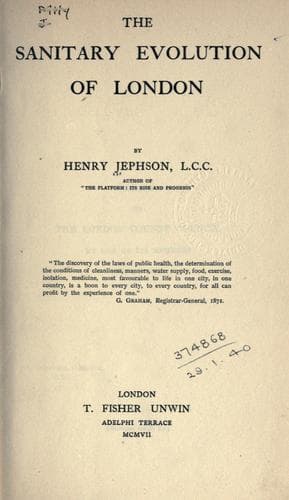
The Sanitary Evolution of LondonJephson, Henry (Henry Lorenzo)
History
The Sanitary Evolution of London
Jephson, Henry (Henry Lorenzo)
Public health -- England -- London
Though something was being done as regarded the inspection of houses
and the repair of sanitary defects, hardly any progress could be said
to have been made for the improvement of the dwellings of the poor.
The Artizans' and Labourers' Dwellings Act (Torrens) of 1868 was to a
small extent being made use of.
In some parishes houses considered by the Vestry or District Board
as unfit for human habitation had been closed, and were only allowed
to be reopened upon proper repairs having been carried out. In other
cases where no amount of repairs could put the house into habitable
condition, the landlord was directed to pull down the buildings
(without his receiving any compensation), and, in default, the Vestry
could pull it down at his expense. The site remained unoccupied, until
the owner or landlord used it again for building purposes, or sold it
to some one else.
In St. Giles' (1873-4) the District Board has been enabled under the
Act to enforce "considerable improvements in and immediately adjoining
the worst parts of St. Giles'." (Houses in yards and courts were
demolished.)
In St. Luke the total number of houses "pulled down or closed" amounted
by the year 1875 to 104.[133]
In Holborn the Board had been--
"Applying or threatening to apply the Act to houses that could be
fairly subjected to it. Besides having 150 houses, chiefly belonging to
one owner, put into a complete sanitary repair, it has been actually
applied to 136 houses; 70 thoroughly repaired, 40 demolished, 26 to be
rebuilt, and 10 to be closed."
There were many difficulties in using the Act. Notice of houses being
unfit had to be given to "owners." A certain case in Chelsea was
mentioned where--
"There were freeholders, lessees, under-lessees, and sub-lessees, and
their trustees and mortgagees, and besides there were the occupiers."
But in the great majority of parishes or districts no steps were taken
under the Act. The Act did not give any compensation to the owners of
condemned property, as Parliament had declared by it that compensation
should not be given to those who permitted their property to fall into
such a state, whilst at the same time extracting the fullest benefit
from it.
To such a doctrine there was, of course, the strongest hostility by
all those who held the opinion that a man might do as he liked with
his own, and extract from it the uttermost farthing regardless of the
infliction of disease and suffering and death upon those who were so
unfortunate as to become his tenants, and reckless as to the injury his
action was inflicting upon the community at large. And so:--
"The reluctance of the local authorities to take away a man's property
was insuperable, and consequently no very great demolition took place."
The Medical Officer of Health for St. Pancras wrote (1876):--
Public-domain text, read in full here on John Shaqi.
Reviews
Reviews
No reviews yet
Be the first to share your thoughts on this work.
Elsewhere in the archive
Join the Discussion
Join the discussion
Sign in to leave a comment or review.
Sign InorCreate an account