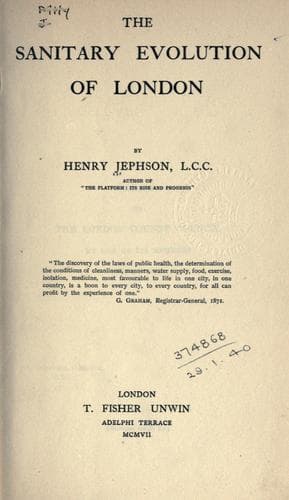
The Sanitary Evolution of LondonJephson, Henry (Henry Lorenzo)
History
The Sanitary Evolution of London
Jephson, Henry (Henry Lorenzo)
Public health -- England -- London
Even the underground kitchens and cellars, which were never intended
for human habitation, were let to tenants, and thus turned to financial
profit.[20] It mattered not that they were without air or ventilation,
or even light; it mattered not that they were damp, or sometimes even
inundated with the overflow of cesspools; it mattered not that they
were inhabited contrary to the provisions of Section 53 of the Building
Act of 1844, for that section was of no operative effect whatever. It
is true that "Overseers" were to report to the "Official Referees," who
were to give notice to and inform the owners and occupiers of such
dwellings as to the consequences of disobeying the Statute, and the
"District Surveyor" was to carry out the directions of the Referees.
But nothing was ever done--Overseers, District Surveyors, and Referees,
all neglected their duties.
Overcrowding was usually at its worst in one-room tenements, and in an
immense number of cases in the metropolis one room served for a family
of the working or of the labouring classes. It was their bedroom, their
kitchen, their wash-house, their sitting-room, their eating-room,
and, when they did not follow any occupation elsewhere, it was their
workroom and their shop. In this one room they were born, and lived,
and slept, and died amidst the other inmates.
And still worse, in innumerable cases, more than one family lived in
one room.
When this one room was in a badly drained, damp, ill-constructed,
and unventilated house, reeking with a polluted atmosphere, and that
house was in a narrow and hemmed-in, unventilated "court" or "place"
or "alley"--as an immense number of them were--the maximum of evil
consequences was attained.
The evils of overcrowding cannot be summed up in a phrase, nor be
realised by the description, however graphic, of instance upon
instance. The consequences to the individual living in an overcrowded
room or dwelling were always disastrous, and, through the disastrous
consequences to great masses of individuals, the whole community was
affected in varying degree.
Physically, mentally, and morally, the overcrowded people suffered. Not
a disease, not a human ill which flesh is heir to, but was nurtured and
rendered more potent in the human hothouse of the overcrowded room; and
the ensuing ill-health and diseases not alone doubled the death rate,
but increased from ten to twenty-fold, at least, the number of victims
of disease of one sort or another--diseases dealing rapid death, or
slowly but surely sapping human strength and vitality.
In the report of the London Fever Hospital for 1845 a certain
overcrowded room in the neighbourhood was described--a room which was
filled to excess every night, sometimes from 90 to 100 men being in it;
a room 33 feet long, 20 feet wide, and 7 feet high. From that one room
alone no fewer than 130 persons affected with fever were received into
the hospital in the course of the year.[21]
Public-domain text, read in full here on John Shaqi.
Reviews
Reviews
No reviews yet
Be the first to share your thoughts on this work.
Join the Discussion
Join the discussion
Sign in to leave a comment or review.
Sign InorCreate an account