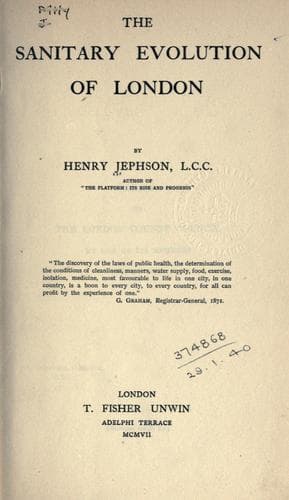
The Sanitary Evolution of LondonJephson, Henry (Henry Lorenzo)
History
The Sanitary Evolution of London
Jephson, Henry (Henry Lorenzo)
Public health -- England -- London
Thus, in the eighteen hundred and forties a new street--New Oxford
Street--was formed. It was driven through "a hive of human beings,
a locality overflowing with human life." Evidence given before the
Commission in 1847 described the results:--
"The effect has been to lessen the population of my neighbourhood by
about 5,000 people, and therefore to improve it at the expense of other
parts of London. Some have gone to the streets leading to Drury Lane,
some to St. Luke's, Whitechapel, but more to St. Marylebone and St.
Pancras. The vestries of St. Marylebone and St. Pancras disliked this
very much. Places in the two latter parishes which were before bad
enough are now intolerable, owing to the number of poor who formerly
lived in St. Giles'."
And a year or so later, from across the river, came the complaint from
Lambeth that "owing to the number of houses pulled down in Westminster
and other places, there had been a great influx of Irish and other
labourers which necessarily caused a great overcrowding of the
miserable domiciles already overfull."
This Lambeth complaint is specially interesting, as it refers to
another great cause of overcrowding--the constant immigration into
London of labourers and poor people in search of work or food.
Owing to the ever increasing and urgent demand for house accommodation
for the working and poorer classes, it became a very remunerative
proceeding for the occupier of a house to sub-let it in portions to
separate families or individuals, and the practice gradually extended
to and absorbed streets hitherto belonging to the better class. The
owner of a property let his whole house to a tenant; this tenant,
seeing an easy way of making money, sub-let the rooms in it in twos or
threes, or even separately, at a very profitable rate to individual
tenants. Nor did the sub-letting end here, for these tenants let off
even the sides or corners of their room or rooms to individuals or
families who were unable to bear the expense of a whole room. And so
the house sank at once into being a "tenement house"--that prolific
source of the very worst evils, sanitary, physical, and moral, to those
who inhabited them.
Public-domain text, read in full here on John Shaqi.
Reviews
Reviews
No reviews yet
Be the first to share your thoughts on this work.
Join the Discussion
Join the discussion
Sign in to leave a comment or review.
Sign InorCreate an account