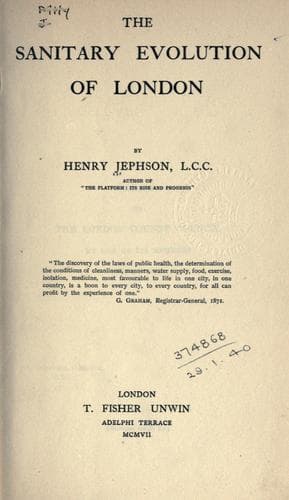
The Sanitary Evolution of LondonJephson, Henry (Henry Lorenzo)
History
The Sanitary Evolution of London
Jephson, Henry (Henry Lorenzo)
Public health -- England -- London
Several inquiries of the sort suggested by the Royal Commissioners
were held in the course of the ensuing years and reports presented to
Parliament, but it is much to be doubted whether they had any effect
in so inciting public opinion as to make it insist on the recalcitrant
local authorities carrying the laws into effect.
Clerkenwell, Mile-End-Old-Town, Bethnal Green, and Rotherhithe, were
inquired into, and reported on. The tale was much the same as that set
forth time after time, and year after year, by various Medical Officers
of Health--want of adequate sanitary supervision, numerous neglects by
the Vestries, especially the neglect to make, or, if made, to enforce
Regulations under the Sanitary Acts of 1866 and 1874.
The initiative of dealing with the existing condition of things rested
with the Vestries. It was forcibly pointed out that complaints could
hardly be expected either from the owners of insanitary houses, on whom
the cost of the improvements would fall, or from tenants who are too
often indifferent to considerations of health and cleanliness, and who
in any case would fear to offend their landlords by complaining.
Rotherhithe came in for the strongest condemnation. Of it the
Commissioners reported:--
"It is, in fact, no exaggeration to say that the results of lax
administration abound in Rotherhithe, and especially in houses occupied
by poor persons."
The increase of the sanitary staff was recommended, but the obdurate
Vestry resolved not to increase it.
The absolute necessity of inspection was demonstrated every day of
the year to every Vestry and District Board in the metropolis by the
results of such exceedingly limited inspection as was carried out.
In St. Luke, in 1890, of 1,348 houses inspected 296 were found "in fair
sanitary condition."
In Hackney, in 1887, 5,213 were inspected; 3,620 of them were found
to be wanting in some sanitary requirement, or were so dirty as to
necessitate orders being served for whitewashing and cleaning. In one
street 111 houses were inspected, and in 97 nuisances were found.
In St. Marylebone, in 1884, 2,136 orders were sent out for repairs and
various sanitary improvements. In Hammersmith, 3,377 notices to abate
nuisances were served in 1886. In Westminster, 1,609 notices served for
sanitary defects.
The Medical Officer of Health for St. Saviour, Southwark, reported
(1890-1):--
"The importance of house-to-house inspection may be estimated by the
fact that of 491 houses inspected, it was found necessary in nearly
every instance to serve notice for the carrying out of urgent sanitary
requirements."
In Camberwell there were, in 1889, between 30,000 and 40,000 houses
in the parish, "of which probably one-half should be inspected
periodically."
The Medical Officer of Health of Bethnal Green stated:--
Public-domain text, read in full here on John Shaqi.
Reviews
Reviews
No reviews yet
Be the first to share your thoughts on this work.
Elsewhere in the archive
Join the Discussion
Join the discussion
Sign in to leave a comment or review.
Sign InorCreate an account