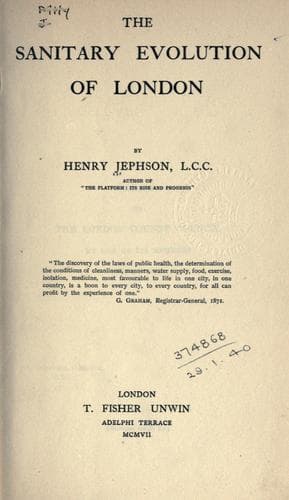
The Sanitary Evolution of LondonJephson, Henry (Henry Lorenzo)
History
The Sanitary Evolution of London
Jephson, Henry (Henry Lorenzo)
Public health -- England -- London
Too horribly gruesome and revolting are the descriptions of these
graveyards--places where the dead were, so to speak, shovelled in as
the filth of the streets is into scavengers' carts, and which "gave
forth the mephitical effluvia of death"; such a one as that in Russell
Court, off Drury Lane, where the whole ground, which by constant
burials had been raised several feet, was "a mass of corruption"
which polluted the air the living had to breathe, and poisoned the
well water which in default of other they often had to drink. Or
those in Rotherhithe, where "the interments were so numerous that the
half-decomposed organic matter was often thrown up to make way for
fresh graves, exposing sights disgusting, and emitting foul effluvia."
The master hand of Dickens has given a more vivid picture of one of
these places than any to be found in Parliamentary Blue Books:--
"A hemmed-in churchyard, pestiferous and obscene, whence malignant
diseases are communicated to the bodies of our dear brothers and
sisters who have not departed.... Into a beastly scrap of ground, which
a Turk would reject as a savage abomination, and a Caffre would shudder
at, they bring our dear brother here departed to receive Christian
burial. With houses looking on on every side, save where a reeking
little tunnel of a court gives access to the iron gate--with every
villainy of life in action close on death, and every poisonous element
of death in action close on life--here they lower our dear brother down
a foot or two; here sow him in corruption, to be raised in corruption;
an avenging ghost at many a sick bedside; a shameful testimony to
future ages, how civilisation and barbarism walked this boastful island
together."
Interments in the vaults of the churches--then a common practice--were
also a fruitful source of sickness and death. It mattered not whether
or not the bodies were hermetically closed in leaden coffins, for
"sooner or later every corpse buried in the vault of a church spreads
the products of decomposition through the air which is breathed,
as readily as if it had never been enclosed"; thus adding to the
contamination of the atmosphere.
The death-roll from this horrible condition of things cannot be gauged,
but those most conversant with the matter were firmly convinced that it
was the direct cause of fevers, and of all kinds of sickness among the
people.
Pollution of the atmosphere which people had to breathe, and upon the
purity of which the public health in varying degree depended, was
caused also by various businesses and processes of manufacture grouped
together under the name of "noxious trades," such as bone-boilers,
india-rubber manufacturers, gut-scrapers, manure manufacturers,
slaughterers of cattle, and many others.
In 1849[25] a description had been given of a street in Shoreditch
which shows to what extent this evil had attained:--
Public-domain text, read in full here on John Shaqi.
Reviews
Reviews
No reviews yet
Be the first to share your thoughts on this work.
Join the Discussion
Join the discussion
Sign in to leave a comment or review.
Sign InorCreate an account