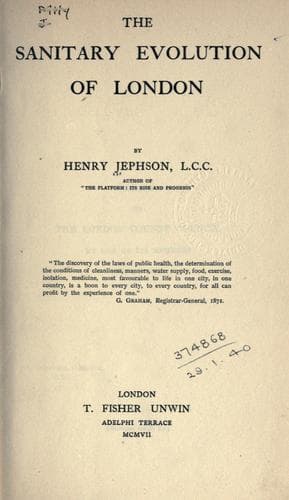
The Sanitary Evolution of LondonJephson, Henry (Henry Lorenzo)
History
The Sanitary Evolution of London
Jephson, Henry (Henry Lorenzo)
Public health -- England -- London
"It is impossible to believe, passing through this main street, that
so great a number of pigsties, bone-boileries, dog-and-cat's meat
manufactories, and tallow-melting establishments, on a large scale
... should exist in a densely-crowded and closely-built locality. The
noxious trades and occupations which so greatly abound here exerted a
most deleterious influence upon the health of the inhabitants."
Parliament, in 1844, had enacted with regard to several of these that
it should not be lawful for any person to establish any such business
at a less distance than 40 feet from the public way, or than 50 feet
from any dwelling-house; and that it should not be lawful to erect a
dwelling-house within 50 feet of such businesses.
But these legislative restraints were utterly inadequate as any sort of
check upon the evil; for, even if a nuisance were abated, there was no
law to prevent its repetition, and so the evil promptly re-appeared.
The stenches did not limit their sphere of action by feet, but
distributed their abominations over large areas; and the manufacturers
cared not what nuisances they subjected people to, nor how far the
horrid smells were wafted by the winds, so long as they themselves
could carry on a profitable business. And the intentions of Parliament
were wholly frustrated by the District Surveyors, who were charged with
the enforcement of the Act, and who wholly failed in their duty.
As for slaughter houses, until 1851 any person could start one who
pleased, and practically where he pleased, subject only to the shadowy
restriction of the common law as to doing anything which might be
considered a nuisance.
And so these numerous and various abominations, mixed with the impurity
of the atmosphere caused by the masses of smoke emitted from the
chimneys of factories and private houses, and with the sickening smell
from the Thames, spread sickness and death throughout great portions
of the metropolis, and were one of the great causes of its insanitary
condition.
CHAPTER I, PART II
Previous to the fifth decade of the last century it was only very
rarely that the prevalence of disease, or any subject connected with
the health of the community, received recognition by Parliament.
In 1840 the Medical Society of London, in a petition to Parliament,
called attention to the increase of smallpox, and to its preventability
by vaccination, and to the imperfect means of vaccination throughout
the country.
The mortality from this--"one of the greatest pests that ever afflicted
humanity"[26]--was very great. In one city in the south of England no
less than 500 persons had died of it in one year. In London in 1839
upwards of 1,000 had died of it.
Public-domain text, read in full here on John Shaqi.
Reviews
Reviews
No reviews yet
Be the first to share your thoughts on this work.
Join the Discussion
Join the discussion
Sign in to leave a comment or review.
Sign InorCreate an account