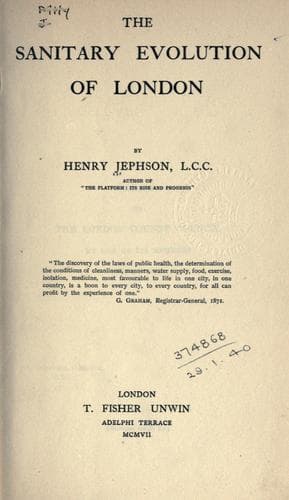
The Sanitary Evolution of LondonJephson, Henry (Henry Lorenzo)
History
The Sanitary Evolution of London
Jephson, Henry (Henry Lorenzo)
Public health -- England -- London
"In regard to some infectious cases, notably those of scarlet fever and
diphtheria, there are no means at all to be compared to isolation in
hospital for preventing the spread of a limited number of cases into a
formidable epidemic.
"And the wonderful and repeated checks to small outbreaks of smallpox
in the metropolis in the course of the past seven years bears
overwhelming evidence to the truth of this dictum."
As the population of the metropolis increased in density it became more
and more necessary in the interests of the people as a whole to make
proper and sufficient provision for the prompt isolation of those of
its inhabitants who might be smitten with infectious disorders.
Home isolation in London was difficult even under the best
circumstances, but in the smaller tenements it was impossible.
"The removal to hospital of so many of the cases (of scarlet fever) is
a vast blessing to this neighbourhood," wrote the Medical Officer for
St. Mary, Newington, in 1897.
For some time a growing tendency on the part of the public to accept
hospital treatment for infectious cases had been evinced.
"The 'depauperisation' of the Hospitals had led to a great increase in
the admissions, so that the public are on the whole very willing to
take advantage of the facilities offered for having their infectious
sick cared for in hospital, whereby the other members of the patient's
family can follow their avocations without hindrance and without risk
to the public generally."
The Chief Sanitary Inspector for Bethnal Green gives information as to
the numbers who from his parish availed themselves of the hospitals.
"A satisfactory feature, and of the greatest assistance in dealing
with infectious disease, is the large number of patients now sent
to hospital. This year nearly two-thirds of the cases notified were
removed. The importance of this either to the patients themselves or to
the public can hardly be overestimated."
By the Public Health London Act, 1891, every inhabitant of London
suffering from any dangerous infectious disease was entitled to free
treatment at one of these hospitals.[181] On receipt of notice an
ambulance was at once sent for his removal.
Year by year greater use was made of the Board's hospitals, and at
times there was not sufficient room in the Metropolitan Asylums
hospitals to receive all the cases. In 1892 the total number of
patients received amounted to over 13,000, there being at one time
4,389 patients suffering from all classes of fever or diphtheria
receiving treatment in the hospitals, whilst in 1893 the admissions
amounted to 20,316.
By 1895 the Board had eight fever hospitals, including diphtheria, with
3,384 beds; three ships for smallpox cases with 300 beds; and a large
hospital for convalescents with 1,200 beds. By 1898 the accommodation
had reached the large total of about 6,000.
The Chairman of the Metropolitan Asylums Board, reviewing in 1897 the
thirty years' work of the Board, said:--
Public-domain text, read in full here on John Shaqi.
Reviews
Reviews
No reviews yet
Be the first to share your thoughts on this work.
Elsewhere in the archive
Join the Discussion
Join the discussion
Sign in to leave a comment or review.
Sign InorCreate an account